
Entertainment: The "Human-Only" Filter: Why AI-Detection is the 2026 Music Industry Baseline
- InsightTrendsWorld

- 6 hours ago
- 5 min read
Why The Trend Is Emerging: From "Creative Tool" to "Algorithm Pollution"
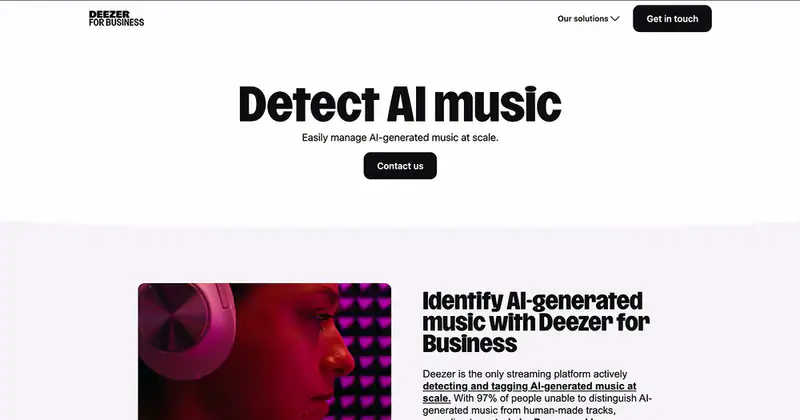
In March 2026, the music industry is hitting a breaking point with "AI Slop." Deezer’s decision to commercialize its AI Music Detector marks the moment platforms stopped fighting AI individually and started building a unified "Digital Border Control." This trend is emerging because the volume of synthetic uploads has reached a staggering 60,000 tracks per day—roughly 39% of all new music—threatening to drown out human artists and bankrupt royalty pools.
The Accuracy Arms Race: With 99.8% accuracy, detectors are now the only thing standing between a "Human" playlist and a bot-generated "Mood" loop.
Royalty Reclamation: In 2025, Deezer flagged 13.4 million AI songs. The goal isn't just to label them, but to demonetize them, ensuring that $200M to $2B in "stolen" royalties flows back to real creators.
The Trust Deficit: 97% of people can no longer tell the difference between human and AI music. Platforms are pivoting to "Transparency as a Service" to prove to listeners that their "Flow" isn't a hallucination.
Standardizing Provenance: By licensing this tech to agencies like Sacem, the industry is creating a "Universal Truth Layer" for music.
Bot-Farm Fatigue: Up to 85% of AI streams are proven to be fraudulent (bot-driven). Detection is now a financial survival strategy, not just a moral one.
Virality of Trend (Social Media Coverage): We’re seeing a massive #HumanMade movement on TikTok and X. Fans are using "Detection Apps" to "audit" their favorite playlists, outing "Ghost AI" artists. The "Deezer Detector" has become a meme for quality control, with fans demanding an "Organic Only" toggle on every streaming app.
Where it is seen (in what industries): Primarily Streaming Platforms (Spotify/Apple Music adopting similar tech), Rights Management (royalty auditing), and Digital Forensics (verifying deepfake audio for legal use).
Description Of The Consumers: The "Authenticity Activists"
These are listeners who are tired of "generic" sounds and are willing to pay a premium for human-verified content.
Name and definition: The Authenticity Activists—consumers who view "Human-Made" as a luxury label.
Demographic description: Gen Z and Millennials who grew up with AI and are now pushing back against "over-processed" culture.
Core behavioural trait: They check the "Metadata" before they hit "Follow." They prioritize artists who share "Behind the Scenes" (BTS) studio footage as proof of life.
Core mindset: "If a bot wrote it, I don't want to feel it."
Emotional driver: Connection. The need to know there is a human soul behind the lyrics.
Decision-making pattern: They follow niche tastemakers and human curators over algorithmic "Daily Mixes."
Main Audience Motivation: The Search for "The Real Deal"
The primary driver is the desire for Transparent Consumption. Fans want to know what they are "feeding" their ears.
Primary motivation: Artist Advocacy. Knowing their subscription fee is going to a person, not a server farm.
Secondary motivation: Curation Control. The ability to "filter out" synthetic audio to keep their discovery feeds pure.
Emotional tension: The wonder of "cool" AI tech vs. the fear of "cultural sameness."
Identity signal: "I support real art."
Trends 2026: The "Provenance" Era
We are moving toward a world where every piece of media comes with a "Digital Birth Certificate."
What is influencing: The rise of "Watermarking 2.0" and the "Organic Art" movement.
Macro trends influencing: "Economic Fairness" in the creator economy and "Anti-Fraud" tech booms.
Innovation/Novelty: It turns "Audio Forensics" into a consumer-facing feature.
Business differentiation: "Human-Only" is becoming the new "Organic/Non-GMO" for the ears.
Insights: Truth is the new Viral — In a world of infinite AI "slop," the brand that can prove it’s real wins the most trust.
Trend Name | Description | Implications | Main Strategy | Main Consumer Motivation |
Main Trend: Provenance Platforms | Using AI-detectors to tag and verify the "origin" of content. | Creates a "Verified Human" status for artists. | Cultural Immersion | Tangible Resonance |
Strategy to Benefit: Demonetization as Defense | Automatically cutting off royalties to bot-driven AI tracks. | Protects the "middle-class" artist from royalty dilution. | Agile Frameworks | Risk Mitigation |
Main Consumer Motivation: Accountability | The demand for platforms to tell the truth about what is AI-made. | Rebuilds trust in a "post-truth" digital world. | Participation Loops | Autonomy |
Social Trend: The #HumanVerified Badge | Artists posting "Detection Scores" to prove their music is 100% human. | Becomes a new standard for social proof and credibility. | Co-Creation Content | Verification |
Industry Trend: Detection-as-a-Service | Companies like Deezer selling "Truth Tools" to competitors. | Establishes an industry-wide "Safety Net" against fraud. | Flex-Lease Models | Efficiency |
Related Trend 1: Tiered Royalties | New pay structures where Human-Made music earns a higher rate. | Directly incentivizes human creativity over AI volume. | Cultural Credibility | Belonging |
Related Trend 2: Audio Watermarking | Invisible signals embedded in AI music for instant identification. | Makes "stealth AI" impossible to maintain long-term. | Hyper-Localization | Curation |
Related Trend 3: "Proof of Life" Content | Fans demanding raw, unedited studio sessions to verify authorship. | Moves marketing from "Polished MV" to "Process Porn." | Meta-Engagement | Social Proof |
Final Insights: The "Verified" Future
In 2026, the question isn't "Is it good?" it's "Is it real?"
Insights: Connection is the new Currency. It’s no longer about the "Stream"; it’s about the "Source."
Industry Insight: Streaming is no longer just a "Player"; it's a "Policeman." Platforms that don't verify their catalogs will lose the "Authenticity Activist" to niche, human-centric competitors.
Consumer Insight: People are willing to forgive "imperfection" if it’s "human." The "un-polished" demo is worth more than the "AI-perfect" hit.
Social Insight: We are entering the "Post-Synthetic Backlash." The "Verified Human" badge will soon be more important than the "Blue Checkmark."
The "Chain of Custody" Economy: Why Radical Traceability is the New Trust Currency
The Trend: Verifiable Provenance. This is the cross-industry shift from "taking a brand's word for it" to demanding hard, unmanipulated data. It utilizes Blockchain-as-a-Service (BaaS) and AI-Reality Checkers to provide a "digital birth certificate" for every physical and digital asset—from the ethical sourcing of a diamond to the "human-only" creation of a news article.
How it Appeared: It emerged from "Truth Fatigue." After years of greenwashing, deepfakes, and "Dead Internet" bots, consumers stopped trusting marketing. The trend accelerated when the EU Digital Product Passport (DPP) and the C2PA standards for digital media moved from "niche tech ideas" to legal and industry requirements in 2026.
Why it is Trending:
The Death of the "Black Box" Supply Chain: Consumers now use AI tools to expose corporate inconsistencies in milliseconds.
Regulatory Survival: Laws now demand "multi-tier transparency" (seeing beyond just your direct supplier) to avoid massive fines for labor or environmental violations.
Status Signals: In 2026, showing the "water footprint" or "ethical step-count" of a product via a QR code has become a higher status symbol than a visible logo.
The Motivation: Radical Accountability. Consumers aren't just looking for "quality"; they are looking for "Moral Safety." They want to ensure their purchases don't accidentally fund conflict, environmental destruction, or "synthetic slop."
Industries Impacted:
Fashion & Luxury: High-end brands use NFC-chipped "Smart Labels" to prove authenticity and resale value.
Food & Agriculture: "Farm-to-Fork" cams and item-level IoT tracking (like "FitChix" pedometers for hens) allow shoppers to audit their groceries.
Journalism & Media: Newsrooms use "Attestation Databases" to prove a video wasn't AI-altered.
Finance & Real Estate: Real-world assets (RWA) like property or carbon credits are tokenized to ensure a clean, unchangeable history of ownership.
How to Benefit:
Open the "Curtain": Don't just say you're sustainable; show the raw, unpolished journey. Use "unvarnished" content over high-gloss ads.
Monetize the History: A product with a verifiable story (e.g., "This bag was made by [Name] in [Location] using [Material]") can command a 20-30% premium over a generic equivalent.
The Strategy: The "Glass Box" Model. Pivot from "Protecting Data" to "Publishing Proof." Integrate Zero-Party Data strategies where customers choose to share their preferences in exchange for seeing the brand's internal data. Turn your supply chain from a back-end cost into your front-end marketing "Lore."
Target Consumers: The "Truth-Seekers" (Gen Z & Alpha). These digital natives treat transparency as an ethical imperative. They use AI "Reality Checkers" as a default shopping filter and will blacklist any brand that feels "vague" or "evasive."
Link to Main Trend: This is the bedrock of "The Authenticity Era"—the definitive transition from the "Information Age" to the "Verification Age."

Comments