
Fashion: Heels as Authority Objects: When Celebrity Footwear Becomes a Signal of Power and Cultural Control
- InsightTrendsWorld

- Jan 9
- 12 min read
Why the trend is emerging: Celebrity styling turns heels into authority objects
This trend exists now because celebrity fashion has shifted from ornamental styling to compressed visual authority, where a single element must communicate confidence, status, and narrative control instantly. The pressure comes from algorithm-driven media environments that reward clear symbols over layered context, pushing heels to carry disproportionate meaning.
Structural driver: Digital platforms fragment red-carpet appearances into cropped, looping visuals, forcing stylists to prioritize items that survive isolation from the full look. Heels anchor posture, gait, and silhouette, making them structurally reliable carriers of meaning even when the rest of the outfit disappears.
Cultural driver: Celebrity culture has evolved from distant aspiration to interpretive intimacy, where audiences decode styling as personal intent rather than costume. Heels gain cultural weight because they signal command, self-authorship, and composure without relying on overt spectacle.
Economic driver: Fashion media and affiliate ecosystems increasingly monetize individual items rather than complete ensembles. A recognizable pair of heels now delivers higher recall, click-through, and resale value than most garments, elevating footwear into a primary economic driver.
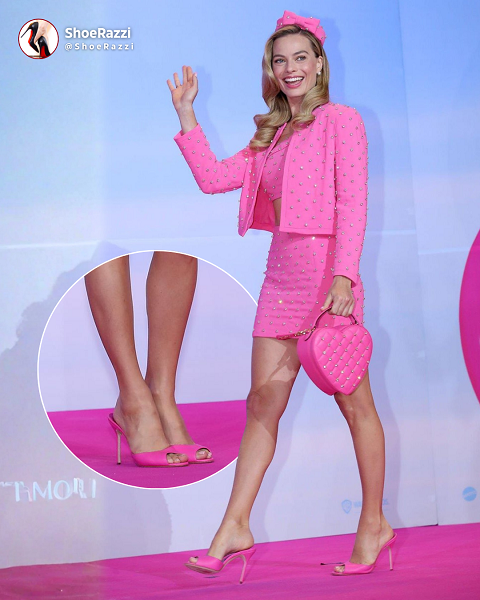
Psychological / systemic driver: In a saturated attention economy, viewers gravitate toward symbols that stabilize memory and meaning. Heels operate as psychological shorthand for transformation and authority, especially when worn by figures like Margot Robbie, whose image blends glamour with controlled power.
Insights: Authority is now read from the ground up
Industry Insight: Fashion and entertainment systems increasingly prioritize single-item dominance because it maximizes cultural recall across fragmented media. Footwear rises in importance because it shapes bodily authority, not just visual appeal.Consumer Insight: Audiences interpret heels as indicators of confidence and intentionality rather than decoration, making them emotionally legible symbols of power. This reframes how style credibility is assigned.Brand Insight: Brands that design heels as narrative tools rather than accessories gain structural advantage in visibility and memorability. Movement, stance, and repeat-view impact become core design criteria.
This shift is structurally locked because visual culture favors elements that communicate authority instantly and persist without context. As celebrity imagery continues to fragment, heels will remain permanent power objects rather than optional fashion accents.
What the trend is: Footwear reframed from decoration into narrative authority
This trend is not about high heels as fashion objects, but about heels functioning as authority devices that stabilize identity, posture, and meaning in fragmented visual culture. It represents a shift where power is communicated physically through stance and movement rather than verbally or symbolically through full outfits.
Defining behaviors: Stylists and celebrities intentionally use heels to control silhouette, gait, and visual dominance, knowing these elements will be isolated in photos and clips. The heel becomes the primary anchor that communicates confidence even when the broader look is cropped or decontextualized.
Scope and boundaries: This logic applies most strongly in celebrity, red-carpet, and influencer environments where images circulate faster than narratives. It is less about daily wear and more about moments designed for cultural capture and replay.
Meaning shift: Heels move from being read as ornamental or sexualized accessories to being interpreted as tools of command and composure. The emphasis shifts from attractiveness to authority and presence.
Cultural logic: In a culture trained to read power visually and instantly, the body becomes a signaling system. Heels operate as structural punctuation marks that signal control, intention, and self-authorship without explanation.
Insights: Definition replaces aesthetics as the core value
Industry Insight: Fashion increasingly prioritizes items that can carry narrative weight independently of full styling. This redefines footwear from category-level product to meaning-bearing asset.Consumer Insight: Viewers subconsciously interpret heels as evidence of confidence and control rather than style alone. This reshapes how authority is perceived in visual culture.Brand Insight: Brands that frame heels around posture, movement, and presence rather than trend cycles gain longer cultural relevance. Definition and symbolism outperform novelty.
This definition locks the trend beyond aesthetics by tying heels to how power is visually constructed. Once authority is encoded through footwear, the logic becomes repeatable, teachable, and difficult to reverse.
Detailed findings: Visual repetition turns heels into behavioral proof
This shift is provably real because the same visual logic repeats across red carpets, premieres, press tours, and digital circulation without coordination. Heels consistently emerge as the most referenced, replayed, and commented-on element even when outfits change.
Market / media signal: Fashion coverage increasingly headlines footwear over garments, with articles, social clips, and stills isolating shoes as the defining feature of a look. This indicates a media logic that recognizes heels as the highest-yield visual unit.
Behavioral signal: Celebrities and stylists repeatedly return to structurally dominant heels—sharp stilettos, platforms, strappy minimal designs—despite changing trends. This repetition signals strategic intent rather than aesthetic coincidence.
Cultural signal: Audience commentary focuses on stance, stride, and leg line rather than fabric or cut, revealing how viewers are trained to read power from posture. Heels become the cultural shorthand through which presence is evaluated.
Systemic signal: Algorithms amplify visuals that show motion, confidence, and clarity, rewarding content where heels visibly shape movement. This systemic reinforcement accelerates the elevation of footwear as a proof point of authority.
Insights: Repetition confirms meaning faster than messaging
Industry Insight: When the same product category consistently outperforms others in attention metrics, it becomes structurally privileged within styling strategy. Heels now function as performance assets rather than fashion details.Consumer Insight: Repeated exposure trains audiences to associate heels with control and legitimacy, making the signal feel natural rather than constructed. This normalizes authority-driven styling.Brand Insight: Brands that benefit most are those whose designs remain legible across repeated appearances and angles. Consistency beats novelty in algorithmic environments.
These findings validate the shift because they show convergence across media, behavior, and systems. When all layers reinforce the same signal, the trend moves from emerging to embedded.
Main consumer trend: Visual authority replaces verbal or symbolic power
Consumers now orient their sense of power, confidence, and credibility around how authority looks rather than how it is explained. Choice, valuation, and admiration increasingly favor elements that project control instantly within visual-first environments.
Thinking shift: Power is no longer primarily associated with status markers or narratives, but with physical composure and visual clarity. Consumers read authority through stance, balance, and posture rather than logos or backstory.
Choice shift: Items that visibly shape the body and movement are prioritized over those that merely decorate it. Heels gain preference because they transform how presence is perceived in motion.
Behavior shift: Consumers increasingly share, save, and emulate looks that communicate strength through form rather than excess styling. This reinforces footwear as the core replicable element of aspirational imagery.
Value shift: Confidence, control, and legibility now outweigh novelty and trendiness in determining desirability. Heels that consistently project authority accrue long-term value over time.
Insights: Consumers reward clarity over complexity
Industry Insight: Consumer demand increasingly favors products that visually encode confidence without explanation. This pushes fashion toward form-driven authority rather than narrative-heavy branding.Consumer Insight: Viewers feel more secure aligning with symbols of control than with fleeting trends. Authority becomes a comfort signal in unstable cultural conditions.Brand Insight: Brands that design for visible control—balance, elevation, posture—tap into deeper consumer valuation drivers. Emotional reassurance outperforms aesthetic surprise.
This consumer logic anchors the trend because it aligns personal aspiration with visual efficiency. Once authority becomes something that must be seen instantly, reversal becomes culturally impractical.
Description of consumers: Visually fluent lives create posture-aware identities
These consumers are shaped by environments where visibility, circulation, and interpretation are constant conditions of daily life. Their identity posture is built less around self-description and more around how presence is read by others in compressed visual moments.
Life stage: These consumers move through careers, social spaces, and digital platforms where perception often precedes explanation. They are accustomed to being seen, evaluated, and remembered through fragments rather than full narratives.
Cultural posture: They value composure, self-command, and control because instability dominates broader cultural conditions. Authority becomes a personal stabilizer rather than an institutional guarantee.
Media habits: Their media diet is image-forward and loop-based, favoring short clips, stills, and repeatable visuals over long-form context. This trains them to interpret meaning from posture, stance, and movement cues.
Identity logic: Identity is constructed through signals that survive scrutiny and repetition. Heels function as tools that externalize inner control, making confidence legible without verbal assertion.
Insights: Identity is now performed through physical clarity
Industry Insight: Consumers increasingly live inside systems where visual coherence equals credibility. Products that help stabilize physical presence gain cultural utility beyond fashion.Consumer Insight: These individuals seek items that help them feel composed under observation. Authority-oriented styling reduces anxiety tied to constant visibility.Brand Insight: Brands that understand identity as posture rather than expression design more durable relevance. Supporting composure becomes more valuable than amplifying personality.
This audience reality reinforces the trend because it ties fashion to lived pressure rather than aspiration alone. As long as life remains visually mediated, posture-aware consumers will continue to anchor identity through authority-signaling items.
What is consumer motivation: Emotional stability becomes the reward for visible control
This trend solves an emotional problem rooted in constant exposure, judgment, and interpretive pressure within visual-first culture. Consumers choose authority-signaling items because they reduce uncertainty about how they are perceived.
Core fear / pressure: The fear is misinterpretation or invisibility in environments where attention is brief and unforgiving. Heels mitigate this by projecting decisiveness and presence before explanation is required.
Primary desire: The desire is to feel composed, legitimate, and in control under observation. Elevation, balance, and posture deliver an embodied sense of authority that feels immediately grounding.
Trade-off logic: Consumers trade comfort, subtlety, or neutrality for visual command. The payoff is psychological reassurance that their presence will register clearly and confidently.
Coping mechanism: Authority-driven styling becomes a coping strategy for uncertainty. Heels act as emotional armor, helping individuals feel stable within unstable social and cultural systems.
Insights: Motivation shifts from attraction to reassurance
Industry Insight: Products that deliver emotional grounding outperform those that promise novelty or excitement. Authority-oriented design becomes a stabilizing category in volatile markets.Consumer Insight: Consumers increasingly seek items that help them feel in control rather than admired. Confidence replaces attention as the primary emotional payoff.Brand Insight: Brands that frame heels as tools for composure rather than allure align with deeper emotional needs. Reassurance creates longer-lasting loyalty than desire alone.
This motivation clarifies why the trend deepens rather than fades. When fashion serves emotional regulation, it becomes structurally embedded in behavior rather than discretionary.
Areas of innovation: Authority-first design reshapes fashion systems
Innovation is concentrating where products and experiences actively enhance visible control rather than aesthetic novelty. The most meaningful shifts occur in how heels are designed, communicated, and distributed as performance tools.
Product innovation: Design focuses on balance, structural confidence, and legibility in motion rather than ornamentation. Heel shapes, angles, and materials are engineered to project stability and dominance even in still images.
Experience innovation: Retail and content experiences increasingly emphasize how shoes alter posture and movement. Try-ons, mirrors, and media now center on stance and gait rather than comfort alone.
Platform / distribution innovation: Social and commerce platforms privilege close-ups, slow-motion walks, and cropped visuals that isolate footwear impact. This reinforces heels as standalone conversion and storytelling units.
Attention or pricing innovation: Premium pricing increasingly reflects symbolic authority rather than craftsmanship alone. Consumers pay for the feeling of control and presence encoded in the product.
Marketing logic shift: Messaging moves from trend-led narratives to embodiment-led proof. Demonstration of posture and movement replaces aspirational storytelling.
Insights: Innovation follows power, not novelty
Industry Insight: Innovation now targets how products perform under visual scrutiny rather than how new they appear. Authority becomes a design requirement, not a stylistic option.Consumer Insight: Shoppers respond more strongly to proof of control than to claims of trend relevance. Seeing posture change validates value instantly.Brand Insight: Brands that invest in embodiment-led innovation gain defensibility across cycles. Designing for visual authority creates durable differentiation.
These innovation patterns explain why the trend accelerates instead of diffusing. When systems align around authority performance, reversal becomes structurally inefficient.
Core macro trends: Structural forces lock authority styling into permanence
This trend is difficult to reverse because it aligns with deep economic, cultural, psychological, and technological forces that mutually reinforce one another. Authority-signaling through footwear persists because it solves multiple system-level pressures simultaneously.
Economic force: Attention economics reward instantly legible signals that convert quickly across media and commerce. Heels function as high-efficiency assets because they generate recall, desire, and monetization without narrative support.
Cultural force: Society increasingly values visible composure in the face of instability and institutional erosion. Authority becomes individualized and embodied rather than conferred by titles or structures.
Psychological force: Humans seek grounding cues when environments feel volatile and evaluative. Physical elevation and posture offer subconscious reassurance, making heels psychologically sticky as symbols of control.
Technological force: Algorithms favor visuals that show clarity, movement, and dominance within seconds. Heels consistently perform well within these constraints, ensuring continued amplification and normalization.
Insights: Macro forces converge around visible control
Industry Insight: When economic, cultural, and algorithmic incentives align, reversal becomes unlikely. Authority-oriented products move from trend status to system infrastructure.Consumer Insight: Consumers internalize these signals because they reduce cognitive and emotional friction. Visual authority becomes a learned survival strategy.Brand Insight: Brands operating in alignment with macro forces gain long-term resilience. Designing against them increases irrelevance risk.
These forces confirm permanence because they operate beyond fashion cycles. Once authority becomes structurally rewarded, it remains embedded until the system itself changes.
Summary of trends: When authority becomes wearable infrastructure
This trend reflects a system where power, confidence, and credibility must be visually legible at first glance. Footwear becomes the most efficient carrier of that logic.
The following table synthesizes how the system resolves across consumers, brands, and industry structures. Each element reinforces the same cause → consequence loop.
Trend Name | Description | Implications |
Core Consumer Trend | Visible authority first — Consumers prioritize items that instantly project control and presence. | Confidence is judged visually before context or explanation. |
Core Strategy | Posture-led signaling — Brands design for stance, gait, and physical command. | Products must perform under scrutiny, not just style cycles. |
Core Industry Trend | Single-item dominance — One accessory carries disproportionate narrative weight. | Footwear outperforms full looks in recall and monetization. |
Core Motivation | Emotional stabilization — Authority reduces anxiety in evaluative environments. | Control becomes more valuable than admiration. |
This system holds together because each layer reinforces the next without friction. Once authority becomes wearable infrastructure, it stops behaving like a trend and starts operating like a requirement.
Trends 2026: When visual authority becomes the default language of confidence
Authority-driven styling accelerates as visual culture compresses further and explanation loses value. Heels remain central because they deliver instant power without narrative dependency.
Trend definition: Authority-first fashion prioritizing posture and stance.
Core elements: Elevation, balance, legibility, and movement clarity.
Primary industries: Fashion, luxury, entertainment, social commerce.
Strategic implications: Products must perform visually before they persuade verbally.
Future projections: Authority signaling spreads beyond heels into tailoring, footwear hybrids, and wearable structure.
Insights: 2026 rewards visible control over expressive complexity
Industry Insight: Markets favor designs that stabilize perception instantly. Authority becomes a baseline expectation, not a premium.Consumer Insight: Confidence is validated through embodiment rather than explanation. Visual clarity reduces social friction.Brand Insight: Brands that design for composure outperform those chasing novelty. Stability becomes aspirational.
This trajectory confirms that authority-led design will define mainstream fashion logic. What once felt symbolic becomes operational.
Social Trends 2026: When confidence becomes a public performance requirement
Social behavior shifts toward embodied proof of legitimacy in response to instability and constant visibility. Authority becomes something individuals must demonstrate continuously.
Implied social trend: Performative composure replaces declarative confidence.
Behavioral shift: People invest in items that manage perception preemptively.
Cultural logic: Power is trusted when it is seen, not claimed.
Connection to Trends 2026: Visual authority becomes the social counterpart to authority-first fashion.
Insights: Society reads control before listening to intent
Industry Insight: Social systems increasingly reward visual certainty. Products that support composure gain social utility.Consumer Insight: Individuals feel safer when their presence communicates control instantly. Embodied confidence reduces interpretive risk.Brand Insight: Brands that align with social confidence pressures gain cultural relevance. Supporting presence becomes a social service.
Final insight: Authority shifts from institutions to the body itself
This shift cannot be undone because authority is no longer granted by context, title, or narrative, but proven visually through physical control. What changes is how power is recognized: it is felt through posture and presence before it is ever explained.
Core truth: Visual authority now precedes verbal legitimacy. Heels act as embodied proof of control in environments that reward instant readability.
Core consequence: Fashion becomes a system for stabilizing power rather than expressing taste. Footwear evolves into a structural tool for managing perception.
Core risk: Authority signaling can flatten diversity of expression if over-standardized. When power cues converge, subtlety risks being misread as weakness.
Insights: Power becomes something you physically perform
Industry Insight: Authority-driven styling redefines success metrics from trend relevance to perceptual control. Products that shape presence gain long-term strategic value.Consumer Insight: Consumers adapt by embodying confidence rather than explaining it. Physical signals reduce the emotional cost of constant evaluation.Brand Insight: Brands that help wearers feel structurally composed gain trust beyond fashion cycles. Power-supporting design becomes a loyalty engine.
This seals the meaning of the trend because it aligns fashion with survival logic rather than aspiration. Once authority is embodied, it becomes a permanent cultural requirement.
These social dynamics ensure endurance because they are rooted in lived pressure, not preference. As long as visibility defines value, authority will be worn, not explained.
Main trend
Embodied authorityPower and credibility are communicated through physical presence and visual control rather than identity, narrative, or status symbols.
Main brand strategy
Design for visible controlCreate products that shape posture, stance, and movement so authority is instantly legible in visual-first environments.
Main industry trend (fashion)
Authority-first stylingFashion prioritizes structure, balance, and silhouette that project command over trend novelty or expressive excess.
Main consumer motivation
Emotional stability through controlConsumers seek items that reduce uncertainty and judgment by making confidence immediately readable.


Trend shows heels becoming symbols of authority, posture, and confidence in a visual culture, and I like this clear, strong communication approach, the same reason I would use Lounge phone number where the site offers helpful support tools and an easy way to get assistance when I need it.