
Media: The Nose Knows: How Billboards Are Becoming Pet-Rescue Beacons
- InsightTrendsWorld

- Dec 20, 2025
- 11 min read
What Is the Functional Advertising Trend: When Billboards Get Jobs
Scent-Driven Tech Meets Street-Level Rescue
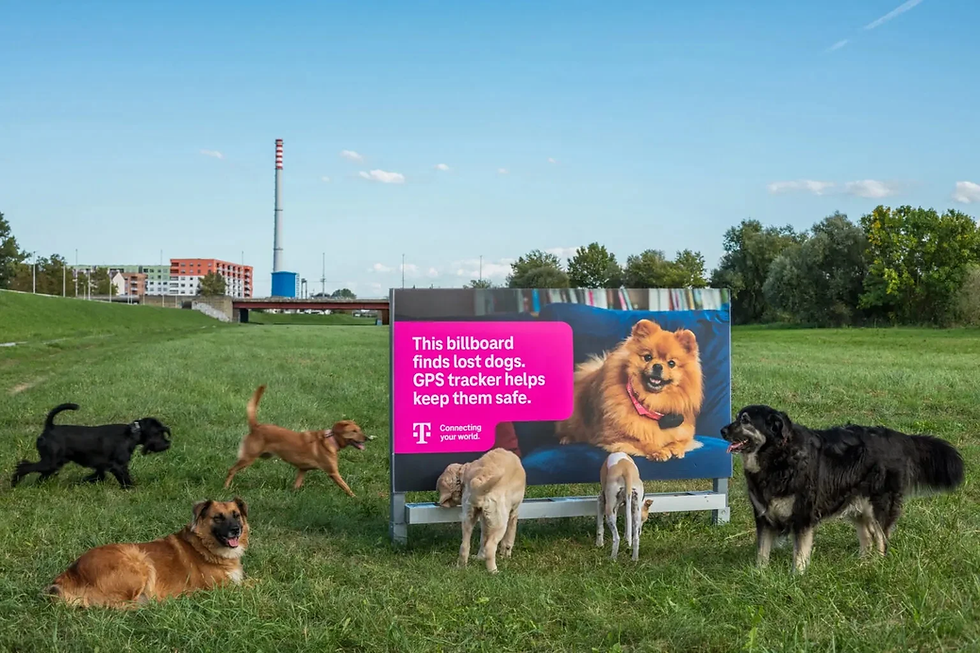
Billboards are going from static eyesores to functional lifelines. Hrvatski Telekom's food-scented installations combine olfactory attraction with GPS tracking to reunite lost dogs with their owners, transforming passive advertising into active problem-solving infrastructure.
Billboard Bait: Food-scented panels draw wandering dogs using canine instinct rather than human spotting
GPS-Guided Comfort Zones: Integrated water bowls keep animals calm while owners track their location via Hrvatski Telekom's Pet Tracker
Strategic Street Placement: Zagreb installations target high-traffic dog-walking zones where strays are most likely to roam
Behavior-Based Design: The system exploits how dogs actually navigate—by nose—rather than hoping for chance encounters
Utility Over Awareness: The billboard demonstrates product capability through real-time intervention instead of static claims
Scalable Infrastructure Model: Concept can deploy near parks, shelters, and trails anywhere lost pets congregate
Insights: Utility replaces interruption when brands solve real problems at the point of need, turning advertising infrastructure into community service.
Industry Insight — Functional Wins Over Flash | OOH advertising earns attention through problem-solving rather than creative volume when utility demonstrates product value in real-time |
Consumer Insight — Help First, Sell Second | Pet owners reward brands that address emotional urgency through tangible action rather than marketing promises |
Brand Insight — Infrastructure Beats Interruption | Hrvatski Telekom positioned as community partner rather than telecom vendor by making billboards work harder than the product they promote |
By addressing the 1,500+ dogs that go missing in Croatia annually, Hrvatski Telekom created a billboard that works harder than the GPS tracker it's promoting. The line between marketing and public service is officially blurred.
Why It's Trending: The Utility Revolution in Brand Experience
Consumer trust in traditional advertising is plummeting. People scroll past, block, and mentally filter out anything that feels like a sales pitch, forcing brands to prove value upfront through functional interventions.
Emotional Stakes Amplification: Pet loss creates urgency that generic advertising can't match—owners will remember who helped
Behavioral Targeting 2.0: The billboard targets actual dog behavior in real-time instead of demographic guessing
Pet Economy Boom: Global pet care spending exceeds $260 billion, making pet-focused solutions commercially viable
Experience Economy Shift: Consumers reward brands that create memorable helpful moments over product feature pitches
Social Proof Through Action: Every rescue generates organic word-of-mouth more powerful than paid media
Technology Accessibility: GPS tracking, scent-release mechanisms, and sensor integration are now affordable at scale
Insights: Emotional urgency accelerates brand loyalty when functional solutions address high-stakes consumer problems traditional advertising ignores.
Industry Insight — Value-First Positioning | Advertising effectiveness depends on utility delivery rather than creative messaging alone when consumer skepticism runs high |
Consumer Insight — Emotional ROI | Pet owners prioritize brands that understand animal behavior and emotional attachment over price-driven competitors |
Brand Insight — Problem-Solving Premium | Hrvatski Telekom converted CSR moment into brand differentiation by solving a problem competitors ignored |
The trend is rising because traditional interruption advertising is dying. Brands either evolve into service providers or fade into the background noise.
Detailed Findings: Turning Infrastructure Into Storytelling
This installation weaponizes empathy at scale. By addressing the 1,500+ annual lost dog cases in Croatia, the brand positioned itself as essential infrastructure rather than optional service.
Scent as Behavioral Currency: Food aroma exploits canine biology, guaranteeing engagement from dogs without human intervention
Passive Surveillance Meets Active Rescue: GPS tracking becomes rescue coordination, proving the product's value through live demonstration
Public Space as Test Lab: Zagreb's dog-walking zones function as real-world product testing grounds visible to potential customers
Empathy-Driven ROI: Each successful reunion generates viral storytelling that amplifies campaign reach organically
Cross-Category Inspiration: The model translates to child safety, elderly care, or any scenario where tracking meets emotional urgency
Infrastructure Brand Positioning: Hrvatski Telekom stops being "just telecom" and becomes community safety partner
Insights: Active demonstration replaces passive messaging when advertising infrastructure performs the exact service it promotes.
Industry Insight — Infrastructure as Marketing | The future of advertising belongs to brands willing to build functional infrastructure that earns cultural relevance through utility |
Consumer Insight — Trust Through Tangibility | People trust brands that prove competence through action rather than those making claims through creative messaging |
Brand Insight — Service as Differentiation | Hrvatski Telekom differentiated in crowded telecom market by making their billboard more useful than the product itself |
The most compelling finding is what the billboard represents. This is proof-of-concept for advertising that works overtime, demonstrating product capability while simultaneously providing community service.
Main Consumer Trend: The Utility-Seeking Audience
The modern consumer filters ruthlessly. They've developed immunity to traditional advertising tactics, demanding proof of value before engagement.
Skepticism as Default: Consumers assume marketing claims are exaggerated until proven through tangible demonstration
Action Over Promises: Pet owners value brands that intervene in real crisis moments rather than building aspirational narratives
Community Service Expectation: Audiences expect brands to contribute functionally to public welfare beyond profit motives
Experience Memory: Helpful brand moments create lasting loyalty more effectively than repeated exposure to messaging
Trust Through Transparency: Functional advertising removes skepticism by making product capability visible and testable
Emotional Decision Priority: When pets are involved, effectiveness trumps price sensitivity in brand choice
Insights: Consumer loyalty shifts toward brands that prove competence through functional intervention rather than competing on messaging creativity.
Industry Insight — Service Integration | Brands winning consumer trust integrate utility directly into marketing infrastructure rather than separating service from promotion |
Consumer Insight — Proof-First Mindset | Modern audiences demand tangible evidence of brand capability before considering purchase, especially in emotionally charged categories |
Brand Insight — Trust Through Action | Hrvatski Telekom built credibility by demonstrating tracker effectiveness through real rescues rather than testimonial campaigns |
The utility-seeking consumer isn't a trend—it's the new baseline. Brands that don't provide value upfront won't get a second look.
Key Success Factors: Building Advertising That Actually Works
The billboard works because it exploits canine behavior, addresses pet owner anxiety, and demonstrates product capability in real-time. Remove any element and the campaign loses its functional edge.
Biological Targeting: Food scent guarantees canine engagement regardless of human awareness or interaction
Emotional Amplification: Pet loss anxiety creates brand recall stronger than traditional frequency-based advertising
Real-Time Proof: GPS tracking proves itself through actual rescue operations rather than hypothetical scenarios
Strategic Placement: High-traffic dog zones maximize exposure to both lost pets and potential customers
Behavioral Design: Water bowls extend dwell time while keeping animals calm and stationary for pickup
Viral Storytelling: Each successful rescue becomes organic content that spreads through pet owner networks
Insights: Success hinges on aligning biological behavior, emotional urgency, and technological proof in a single functional intervention point.
Industry Insight — Multi-Layer Functionality | Winning campaigns stack biological triggers, emotional resonance, and product demonstration into unified experiences |
Consumer Insight — Crisis as Catalyst | Pet owners form strongest brand attachments during moments of acute need rather than routine product usage |
Brand Insight — Demonstration Over Declaration | Hrvatski Telekom let the billboard prove tracker capability instead of relying on claims or testimonials |
Success factors aren't about creative brilliance—they're about functional alignment. When biology, emotion, and technology converge at the point of need, traditional advertising metrics become irrelevant.
Description of Consumers: The Anxious Pet Parent
Pet owners are hyper-engaged, emotionally invested consumers who prioritize animal welfare over price considerations. They're predominantly urban professionals aged 25-45 with disposable income.
Urban Dog Owners: City dwellers navigating parks, streets, and public spaces where pets can easily stray or escape
Income Level: Middle to upper-middle class with spending power for premium pet products and services
Emotional Investors: View pets as family members, making emotional connection the primary purchase driver
Tech-Adopters: Comfortable with GPS tracking, apps, and connected devices for pet safety and health monitoring
Community-Oriented: Frequent dog parks and walking zones, creating social networks around pet ownership
Proactive Safety Seekers: Invest in preventative solutions like GPS trackers before crisis moments occur
Insights: Pet parents prioritize emotional security over cost efficiency, making them ideal targets for utility-driven brand experiences.
Industry Insight — Premium Willingness | Pet owners demonstrate higher willingness to pay for solutions that address emotional security versus basic functionality |
Consumer Insight — Prevention Over Reaction | Anxious pet parents invest in proactive safety measures, creating market opportunities before crisis moments |
Brand Insight — Family Positioning | Hrvatski Telekom tapped into family-level emotional investment rather than treating pets as secondary consumer category |
The anxious pet parent isn't price-sensitive—they're solution-desperate. Brands that acknowledge this emotional reality and provide tangible safety measures win loyalty that transcends traditional customer relationships.
What Is Consumer Motivation: Safety as Emotional Currency
Pet owners aren't buying GPS trackers—they're buying peace of mind. Hrvatski Telekom's billboard taps into deep-seated fears around pet safety and the inability to protect vulnerable family members.
Loss Prevention Anxiety: Fear of permanent pet loss drives investment in tracking technology and safety infrastructure
Control Over Uncertainty: GPS tracking provides illusion of control in unpredictable urban environments
Guilt Avoidance: Proactive safety measures alleviate owner guilt about potential negligence or accidents
Social Identity Protection: Pet loss carries social stigma among pet owner communities, motivating preventative action
Emotional Attachment: Pets function as emotional support systems, making their safety non-negotiable
Trust Through Demonstration: Brands proving they understand pet behavior earn deeper trust than those marketing features
Insights: Motivation centers on emotional security rather than product features, making functional demonstration more powerful than technical specifications.
Industry Insight — Emotional Selling | Pet industry success depends on addressing emotional drivers rather than competing on product features or price points |
Consumer Insight — Fear as Motivator | Pet safety purchases are driven by loss prevention anxiety rather than aspiration or lifestyle enhancement |
Brand Insight — Empathy as Strategy | Hrvatski Telekom positioned as empathetic partner understanding pet owner fears rather than technology provider |
Consumer motivation isn't rational—it's emotional. Brands that acknowledge the fear beneath the purchase decision create loyalty traditional marketing can't touch.
Strategic Trend Forecast: Infrastructure Advertising Goes Mainstream
Functional advertising will evolve from novelty to expectation. Hrvatski Telekom's model becomes the blueprint for how brands justify their presence in public spaces.
Sensor-Driven Advertising: Billboards equipped with environmental sensors responding to real-time conditions and consumer needs
Multi-Purpose Infrastructure: Ad spaces doubling as EV charging stations, WiFi hotspots, emergency communication points
Behavioral Targeting Evolution: Marketing shifts from demographic guessing to biological and behavioral pattern recognition
Service-First Branding: Brands compete on functional utility provided through advertising infrastructure rather than creative messaging
Community Integration: OOH advertising becomes expected civic infrastructure rather than optional commercial presence
Measurable Impact: Campaign success measured by problems solved rather than impressions delivered
Insights: Advertising infrastructure will earn its place in public space through functional contribution rather than rented visibility.
Industry Insight — Utility as Currency | Future advertising revenue models will incorporate civic contribution metrics alongside traditional impression-based pricing |
Consumer Insight — Expectation Inflation | Audiences will increasingly view non-functional advertising as visual pollution rather than acceptable commercial presence |
Brand Insight — Infrastructure Investment | Leaders will shift budgets from creative production toward functional infrastructure that demonstrates brand values through action |
The forecast is clear: advertising either becomes useful or becomes invisible. Brands investing in functional infrastructure now will own the playbook when utility becomes table stakes.
Areas of Innovation: Where Functional Ads Deploy Next
The scent-billboard model translates across any category where emotional urgency meets behavioral targeting. Look for functional advertising expansion in child safety, elderly care, and emergency response.
Child Safety Zones: School-adjacent installations with emergency communication, GPS tracking tie-ins, and safe-waiting areas
Elderly Care Networks: Bus stops and public benches with fall detection, emergency buttons, and caregiver alerts
Public Health Monitoring: Billboards with air quality sensors, hydration stations, and health screening capabilities
Emergency Response Hubs: Ad infrastructure doubling as disaster communication points with backup power and connectivity
Urban Wildlife Management: Installations managing human-animal conflicts in urban areas through behavioral redirection
Mental Health Touchpoints: Public space advertising providing crisis resources, helpline access, and supportive messaging
Insights: Innovation opportunities exist wherever emotional stakes, behavioral patterns, and technological intervention converge in public spaces.
Industry Insight — Cross-Category Potential | Functional advertising frameworks translate across industries when adapted to specific behavioral triggers and emotional drivers |
Consumer Insight — Public Space Expectations | Citizens increasingly expect public infrastructure to provide functional value beyond aesthetic or commercial purposes |
Brand Insight — First-Mover Advantage | Brands establishing functional advertising infrastructure early will own category association before competitors recognize the shift |
Areas of innovation aren't limited by category—they're limited by imagination. Any brand serving a category with emotional urgency can deploy this model.
Core Macro Trends: The Forces Driving Functional Advertising
Multiple macro forces converge to make functional advertising inevitable. Economic uncertainty, urbanization pressures, and technology accessibility push brands toward utility-first approaches.
Economic Pressure: Inflation and cost-of-living concerns make consumers demand tangible value from every brand interaction
Urbanization Intensity: Dense city living creates infrastructure gaps that brands can fill while advertising their solutions
Technology Democratization: GPS, sensors, and connected devices become affordable enough for advertising-scale deployment
Trust Erosion: Declining faith in institutions pushes consumers toward proof-based brand evaluation
Experience Economy Maturation: Consumers value memorable helpful moments over material goods, rewarding service-oriented brands
Social Responsibility Expectations: Audiences demand brands contribute to public welfare rather than purely extracting commercial value
Insights: Macro trends align to reward brands building functional infrastructure while punishing those relying on interruption-based advertising.
Industry Insight — Convergence Opportunity | Multiple macro forces simultaneously favor functional advertising, creating rare alignment for industry transformation |
Consumer Insight — Value Verification | Economic and trust pressures make consumers scrutinize brand claims more carefully, demanding proof before engagement |
Brand Insight — Strategic Timing | Hrvatski Telekom capitalized on macro trend convergence when technology costs dropped and consumer expectations shifted |
Macro trends don't just enable functional advertising—they demand it. Brands ignoring these forces will find traditional approaches increasingly ineffective.
Summary of Trends: The Functional Advertising Framework
Core trends converge around utility-first brand experiences that demonstrate value through infrastructure rather than messaging.
Trend Name | Description | Implications |
Core Consumer Trend: Pragmatic Validation | Utility-Seeking Audiences demand proof before engagement | Brands must demonstrate capability through action rather than claims |
Core Strategy: Functional Infrastructure | Infrastructure as Advertising turns public spaces into functional brand touchpoints | Marketing budgets shift from creative production to utility infrastructure investment |
Core Industry Trend: Utility Over Creativity | Functional Wins Over Flash as advertising effectiveness depends on problem-solving | OOH industry transforms from visibility rental to civic contribution marketplace |
Core Motivation: Emotional Pragmatism | Safety as Emotional Currency drives purchase in high-stakes categories | Brands addressing emotional security outperform those competing on features or price |
The convergence of pragmatic consumer validation, functional infrastructure strategy, utility-focused industry shifts, and emotional pragmatism creates a new advertising paradigm. Brands that align all four trends—proving capability through action, investing in public utility, prioritizing problem-solving over creativity, and addressing emotional security—will dominate categories where traditional interruption advertising fails to break through.
Final Insight: Advertising Earns Attention Through Action
The Croatian billboard isn't a campaign—it's a manifesto. Brands that build functional infrastructure solving real problems will dominate categories where emotional stakes run high.
Utility Replaces Interruption: Functional value justifies brand presence in public spaces more effectively than creative volume
Proof Beats Promises: Demonstrations of capability through real-time intervention outperform testimonials and claims
Emotion Drives Adoption: High-stakes categories like pet safety reward brands addressing emotional urgency over rational features
Infrastructure as Strategy: Public utility investments create brand positioning traditional campaigns can't replicate
Behavior-Based Design: Success depends on understanding and exploiting biological and psychological patterns
Scalability Through Service: Models solving genuine problems replicate across geographies and categories more effectively than creative concepts
Insights: The future belongs to brands willing to invest in infrastructure that works when advertising doesn't.
Industry Insight — Transformation Imperative | Advertising must evolve from attention-seeking to attention-earning or face irrelevance as consumer filtering intensifies |
Consumer Insight — Action as Trust Signal | Tangible problem-solving creates brand loyalty stronger than any frequency-based campaign or creative award |
Brand Insight — Infrastructure Investment ROI | Hrvatski Telekom's functional billboard generates ongoing returns through organic storytelling and community positioning traditional ads can't achieve |
The final insight is simple but brutal: advertising either solves problems or becomes one. Brands building functional infrastructure now will own consumer trust when utility becomes mandatory.
Trends 2025: Pragmatism Powers Pet Tech Infrastructure
The Practical Revolution in Public Space Advertising
Pet safety technology integrates with urban infrastructure as brands embrace pragmatic solutions over flashy campaigns. The $260+ billion pet economy rewards brands that prioritize tangible utility.
Public-Private Pragmatism: Cities and brands collaborate on pet-friendly infrastructure serving practical civic and commercial purposes simultaneously
Sensor-Driven Solutions: Parks, trails, and public spaces equipped with pragmatic pet tracking and safety technology that works 24/7
Behavioral Design Realism: Infrastructure engineered around proven animal psychology rather than theoretical human-only consideration
Emergency Response Networks: Connected systems enabling rapid pet recovery through automated alerts and practical location tracking
Data-Driven Pragmatism: Pet movement patterns informing realistic urban planning and commercial location strategies
Cross-Category Application: Pragmatic model extends to child safety, elderly care, and any category with emotional urgency and tracking needs
Insights: Pragmatism replaces spectacle as pet tech infrastructure represents the first wave of functional advertising that earns placement through practical civic contribution.
Industry Insight — Infrastructure as Pragmatic Media | Public utility infrastructure becomes advertising medium when brands embed practical services that demonstrate product capabilities through real-world application |
Consumer Insight — Practical Expectations Reset | Pet owners expect cities and brands to provide functional safety infrastructure, making pragmatic early movers category definers over creative competitors |
Brand Insight — Pragmatic Category Leadership | Hrvatski Telekom positioned as pet safety innovator rather than telecom commodity through practical infrastructure investment that solves real problems |
Trends 2025 point toward advertising infrastructure becoming expected civic contribution. Brands providing pragmatic, functional value through public space installations will own category association while competitors still buy billboard space.


Comments