
Shopping: Trust Is the New Checkout: How AI Changed Discovery, Not Decision
- InsightTrendsWorld

- Oct 30, 2025
- 6 min read
What Is the Trend: “Assisted Discovery” — AI as the Starting Point, Not the Endpoint
Artificial intelligence has become a daily fixture in digital commerce — but shoppers still call the final shot. The latest joint study by the Interactive Advertising Bureau (IAB) and Talk Shoppe reveals a striking paradox:AI now drives discovery and comparison for nearly half of online consumers, yet 95% of shoppers verify its recommendations elsewhere before purchasing.
AI ranks second only to search engines as the most influential tool in shopping journeys.
450+ recorded AI shopping sessions and 600-person survey show how AI shapes — and elongates — decision pathways.
AI creates more checkpoints: consumers perform 3.8 validation steps on average after using AI, up from 1.6 before.
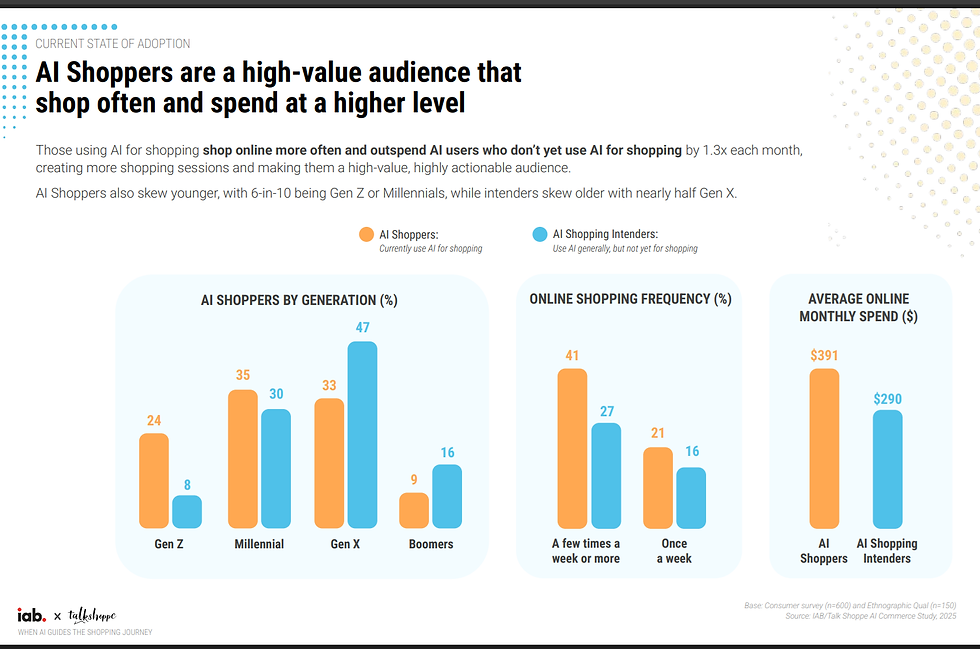
AI-driven consumers outspend others by 30% monthly, but their confidence still depends on cross-verification.
This trend illustrates how AI is expanding, not replacing, traditional discovery — turning instant answers into prompts for deeper trust-seeking behavior.
Why It Is Trending: Trust Has Become the New Currency of AI Commerce
AI’s rise in online shopping highlights a broader shift in consumer psychology — speed without surrender.
Information overload and AI hallucination fears have trained consumers to double-check.
Generational confidence gap: 60% of AI shoppers are Gen Z or Millennials — open to using it, but still skeptical.
Behavioral tension: While 83% say AI makes decisions clearer, nearly 90% confirm information on other sites.
Emotional logic: AI accelerates convenience but lacks credibility — humans still seek validation through community and transparency.
AI has entered the mainstream as a co-pilot, not a commander.
Overview: AI Expands the Funnel, Not Shortens It
The report reframes AI’s commercial role: instead of streamlining purchasing, AI widens the space between discovery and decision.
Consumers use AI to clarify needs, filter clutter, and compare products.
But once the shortlist forms, the verification instinct kicks in — pushing shoppers to brand sites, reviews, and marketplaces.
Retailers see a 3× spike in traffic after AI interactions, with shoppers focusing on price, availability, and authenticity.
The outcome: AI drives high-intent discovery, while human-verified data still drives conversion.
Detailed Findings: The New Consumer Path to Purchase
1. The Early Advantage — Discovery and Comparison
83% of users say AI clarifies their shopping journey.
77% feel more confident post-AI use.
AI is especially useful in complex categories like electronics, apparel, and beauty — where specs, styles, and tiers overwhelm.
64% discovered new products via AI that they wouldn’t have otherwise found.
89% confirm findings through reviews, retailer pages, or social forums before purchase.
2. The Trust Gap — Confidence Without Commitment
Four friction points define why shoppers hesitate to rely solely on AI:
Transparency: Unclear sources or citations trigger skepticism.
Reliability: Outdated or mismatched pricing weakens confidence.
Relevance: Recommendations outside budget or preference feel tone-deaf.
Human validation: Consumers still crave other shoppers’ or experts’ opinions to finalize decisions.
3. The Verification Loop — The New Middle of the Funnel
Shoppers perform more steps after AI, not fewer.
AI adds checkpoints: users validate across brand sites, reviews, price aggregators, and forums.
Retail visits surge: 78% of AI users clicked through to retailers post-interaction.
Once onsite, 75% verify price, 50% check variants, and 40% read user reviews — proving trust is now the core purchase currency.
4. Generational Divide in AI Confidence
Gen Z & Millennials: 60% of AI-assisted shoppers; see AI as a creative assistant but not an authority.
Gen X & Boomers: Slower adoption, higher skepticism, but open to hybrid journeys.
Across age groups: 80% plan to increase AI use but will keep verifying externally.
Key Success Factors of the Trend: The C.L.A.R.I.T.Y. Framework
Credibility: Verification sources must be consistent and transparent.
Linkage: Unified product data across AI, retailers, and search builds trust.
Accuracy: Regular structured data updates prevent misinformation.
Relevance: AI recommendations must match budgets, needs, and intent.
Interactivity: Two-way trust — explain how results are generated.
Transparency: Clear sourcing and verified reviews as table stakes.
Yield: Conversion depends on reassurance, not recommendation.
Key Takeaway: AI Accelerates Curiosity, Not Closure
AI doesn’t end the buyer journey — it redefines its rhythm.
Discovery: Automated, fast, and personalized.
Decision: Human-verified, deliberate, and emotional.
Trust: The bridge between machine speed and human assurance.
For brands, this means AI can fill the top of the funnel with intent, but credibility still determines conversion.
Core Consumer Trend: The Hybrid Decision Maker
Consumers no longer separate human and machine input — they blend both.
They welcome AI’s speed but insist on personal research for validation.
They are data-savvy, privacy-aware, and emotionally driven.
They engage in looped journeys — discovery via AI, decision via community.
Description of the Trend: “AI-Human Co-Shopping”
A new phase in e-commerce where artificial intelligence supports, not replaces, human discernment.
AI manages the rational tasks — filtering data, summarizing specs.
Humans handle emotional reasoning — trust, authenticity, and reassurance.
The result: longer but higher-quality journeys, with stronger brand interactions.
Key Characteristics of the Trend: The T.R.U.S.T. Model
Transparency: Shoppers want to see how answers are sourced.
Reassurance: Verified reviews and community input still rule.
Understanding: Simplicity and explanation outweigh automation.
Synchronization: Consistent data across AI and retail ecosystems.
Touchpoint Expansion: Every validation step becomes a new marketing opportunity.
Market and Cultural Signals Supporting the Trend
Rising popularity of AI shopping assistants on Google, Amazon, and TikTok Shop.
Global growth of “AI-curated commerce” but parallel surge in review-checking platforms.
Increasing regulation around AI transparency and consumer data usage.
Cultural emphasis on digital literacy and self-verification in post-algorithm culture.
What Is Consumer Motivation: Empowerment Through Verification
Shoppers want both convenience and control.
AI saves time, but verifying builds confidence.
Emotional reward: Confirmation feels like smart decision-making.
Social validation: Peer and expert reviews create trust loops.
What Is Motivation Beyond the Trend: “Confidence as Currency”
Consumers don’t just buy products — they buy peace of mind.
Transparency and verified sources create psychological security.
Trust replaces speed as the defining metric of digital success.
Description of Consumers: The Conscious Validator
Age: 18–55, digitally fluent.
Behavior: Uses AI for inspiration, search, and filtering.
Mindset: Curious but cautious; wants confirmation before commitment.
Values: Authenticity, privacy, and data accuracy.
How the Trend Is Changing Behavior: From Funnels to Feedback Loops
The purchase journey is now nonlinear and iterative.
Validation — not checkout — marks the true end of shopping.
Retailers gain multiple brand touchpoints per session.
Decision-making evolves into research as reassurance.
Implications Across the Ecosystem
For Consumers: Empowered with both AI efficiency and human judgment.
For Brands: Must align AI, SEO, and retail data for trust continuity.
For Platforms: Need transparency features and citation systems.
For Marketers: Focus shifts from persuasion to proof — verified data, not slogans.
Strategic Forecast: The Rise of the “Double-Check Economy”
AI tools will become embedded in all major retail ecosystems, but trust verification layers will define competitive advantage.
Expect hybrid shopping models that integrate AI-curation + verified user validation.
Brands investing in explainable AI and transparent sourcing will win long-term loyalty.
Data credibility ≈ brand equity — misinformation will cost market share.
Areas of Innovation: The Verification Tech Stack
Verified data APIs: Structured product details with real-time updates.
AI explainability layers: Displaying how recommendations are generated.
Community-linked assistants: Integrating human reviews into AI chat flows.
Smart contract authenticity tags: Blockchain-based proof of product and source.
Summary of Trends: From AI Accuracy to Human Assurance
AI revolutionized discovery, but trust remains analog.
Speed without credibility is friction, not progress.
Verification has become a core stage in digital shopping.
The future of commerce lies in collaboration between algorithm and authenticity.
Core Consumer Trend — The Hybrid Decision Maker
Consumers blend AI convenience with human verification — seeking both efficiency and emotional confidence.
Core Social Trend — Verification Culture
Misinformation fatigue fuels a culture of cross-checking before believing — or buying.
Core Strategy — Synchronize and Simplify
Brands must align AI outputs, search listings, and retail pages for seamless, verifiable experiences.
Core Industry Trend — Trust-First Commerce
The next retail revolution won’t be powered by AI speed, but by data credibility.
Core Consumer Motivation — Confidence Through Clarity
Buyers want to feel smart and secure, not just served fast.
Core Insight — Discovery Is Easy; Conviction Is Earned
AI can guide attention, but only trust closes the cart.
Trend Implication — The New Competitive Edge Is Credibility
In a world of instant answers, the brand that proves its truth wins the purchase.
Final Thought: AI Can Recommend — Only Trust Can Convince
The modern shopper moves in two gears: machine speed and human sense. AI can light the path, but people still need to see the proof. The next era of digital commerce will not be about who automates fastest, but who validates best.


Comments