


Digital Wellbeing: Gen Z Is Taking Back Control Of Their Algorithms
- InsightTrendsWorld

- 1 day ago
- 11 min read
Gen Z is becoming less willing to let algorithms make decisions on their behalf. After years of hyper-personalized recommendations, many young consumers are actively reshaping their social media feeds, searching for more variety, greater control, and more authentic online experiences. This shift reflects a broader movement toward healthier relationships with technology, where people increasingly want digital platforms to work with them rather than for them.
Why Digital Wellbeing Is Transforming Social Media
For years, social media platforms competed to create increasingly personalized feeds, using algorithms to predict exactly what users wanted to see. While this personalization helped improve engagement, it also created an unintended consequence: many users now feel trapped inside repetitive recommendation loops that limit discovery, creativity, and surprise. Instead of feeling inspired, scrolling often feels predictable.
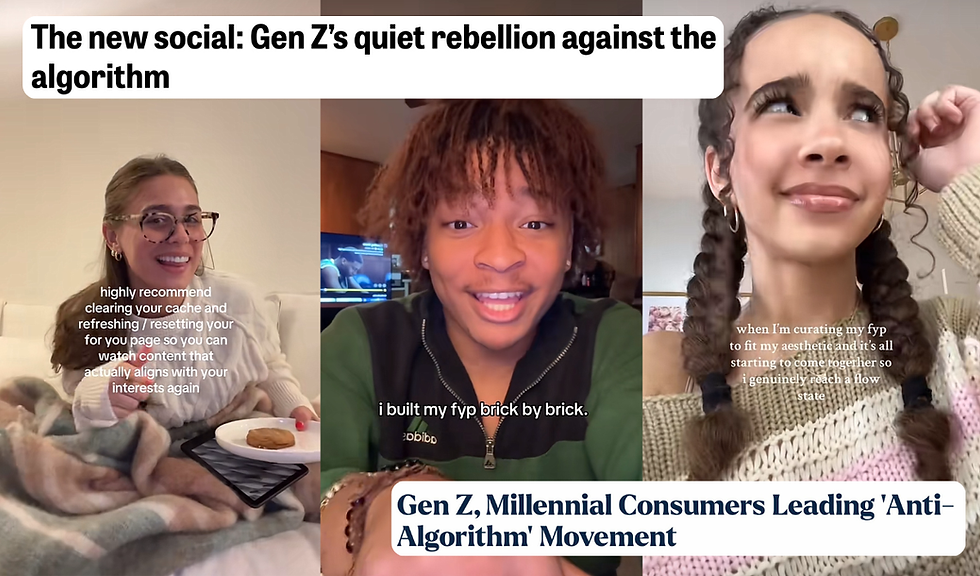
Gen Z is increasingly responding by actively retraining their algorithms. Rather than accepting whatever platforms recommend, many users are resetting feeds, searching for new topics, following different creators, and intentionally engaging with unfamiliar content to diversify their recommendations. This growing behavior reflects a desire to regain control over digital experiences and reduce what many describe as "algorithm fatigue."
➡️ Key Insight: The future of social media will be shaped less by increasingly intelligent algorithms and more by giving people greater control over how those algorithms influence their everyday digital experiences.
Why Everyone Is Talking About Digital Wellbeing
People are becoming more aware of algorithm fatigue. Highly personalized feeds can become repetitive, making digital experiences feel predictable instead of inspiring.
Consumers increasingly want more control over technology. Rather than allowing algorithms to determine everything they see, users are actively shaping their own digital experiences.
Discovery is becoming more valuable than personalization. Consumers increasingly enjoy finding unexpected creators, ideas, and communities instead of repeatedly seeing similar content.
Gen Z is redefining digital wellbeing. Healthy technology use is no longer just about reducing screen time but also about improving the quality and diversity of online experiences.
Platforms are beginning to respond. Social media companies have growing opportunities to introduce features that help users reset, diversify, and better control their recommendations.
➡️ Why It Matters: The next generation of digital experiences will be built around giving users more choice, more discovery, and more control rather than simply delivering increasingly personalized content.
The Big Shift: People Want To Control Technology Instead Of Being Controlled By It
Technology is becoming more personal than ever, but consumers increasingly want that relationship to feel balanced rather than automatic. Instead of accepting recommendations without question, people are becoming more intentional about how algorithms influence what they watch, read, buy, and discover online.
This represents a broader cultural shift toward digital wellbeing. Consumers are no longer measuring technology only by convenience or personalization—they are increasingly valuing autonomy, curiosity, and the ability to shape their own experiences. For platforms and brands, success will increasingly depend on creating technology that empowers people rather than simply optimizing engagement.
➡️ Big Shift: The future of digital platforms will be defined by giving people more control over their online experiences instead of asking them to adapt to increasingly powerful algorithms.
Why Digital Wellbeing Is Growing: People Want More Control Over Their Online Lives
Consumers are becoming more aware of how algorithms shape their decisions. Rather than passively accepting recommended content, many people are questioning whether personalized feeds truly reflect their interests or simply reinforce existing habits.
Discovery is replacing endless personalization. Consumers increasingly enjoy finding unexpected ideas, creators, and perspectives instead of repeatedly seeing similar content chosen by algorithms.
People want technology to feel more balanced. Digital wellbeing is evolving beyond reducing screen time to creating online experiences that feel healthier, more varied, and less repetitive.
Gen Z is becoming more intentional online. Young consumers are actively resetting feeds, following different creators, and engaging with new topics to create digital experiences that better reflect their changing interests.
Control is becoming a competitive advantage. Platforms that give users more transparency, customization, and choice are likely to build stronger trust and longer-lasting engagement.
➡️ Growth Driver: The future of digital platforms will belong to companies that balance smart recommendations with meaningful user control.
What Consumers Want: Technology That Works With Them, Not For Them
Consumers want greater control over what they see. People increasingly expect simple ways to customize recommendations instead of relying entirely on automated algorithms.
People value variety over repetition. Discovering new interests, creators, and communities feels more rewarding than continuously consuming similar content.
Consumers want transparency. Understanding why certain content appears and having the ability to influence recommendations helps build trust in digital platforms.
Consumers appreciate flexibility. Users increasingly want to switch between personalized recommendations and broader discovery depending on their mood, interests, or goals.
Consumers are prioritizing healthier digital experiences. Rather than maximizing time spent online, many people are looking for technology that feels more enjoyable, inspiring, and less mentally exhausting.
➡️ Consumer Insight: Consumers increasingly choose digital experiences that give them more choice, greater transparency, and the freedom to explore beyond algorithmic recommendations.
What This Means For Brands: Digital Wellbeing Is Creating New Opportunities
Trust is becoming more valuable than personalization. Consumers are more likely to engage with brands that respect their preferences instead of relying only on algorithm-driven targeting.
Discovery is becoming a powerful marketing tool. Brands have opportunities to create content that surprises, inspires, and encourages exploration rather than simply reinforcing existing interests.
Transparency builds stronger relationships. Explaining why recommendations appear and giving consumers more control strengthens confidence in digital experiences.
Authenticity is becoming more important than optimization. Consumers increasingly respond to genuine, useful content instead of material designed solely to maximize engagement metrics.
The opportunity extends beyond social media. E-commerce, streaming, news, education, gaming, AI assistants, and digital services can all benefit from giving users more control over personalized experiences.
➡️ Business Opportunity: The brands that earn the greatest trust will be those that help consumers feel in control of their digital experiences instead of simply optimizing for engagement.
Where This Trend Creates Opportunities: Digital Wellbeing Is Expanding Across Industries
Industry | Opportunity |
Social Media | Introduce tools that help users reset, customize, and better understand their recommendation feeds. |
Streaming Services | Offer more flexible discovery modes that balance personalized recommendations with fresh and unexpected content. |
Retail & E-commerce | Give shoppers greater control over product recommendations, interests, and browsing preferences. |
AI & Digital Assistants | Design AI experiences that explain recommendations, adapt to changing preferences, and allow users to guide interactions. |
News & Media | Create discovery features that expose readers to broader perspectives while maintaining relevance. |
Education Platforms | Help learners explore new subjects beyond personalized learning paths without losing flexibility. |
Gaming | Improve recommendation systems by giving players more control over game discovery, content, and communities. |
Technology Platforms | Build user-friendly controls that make personalization feel transparent, flexible, and easy to adjust. |
➡️ Industry Opportunity: The greatest opportunities will come from creating digital experiences that combine intelligent personalization with meaningful user choice, giving consumers greater confidence and control over the technology they use every day.
Why Digital Wellbeing Matters: Digital Wellbeing Is Creating New Consumer Opportunities
As consumers spend more time online, they are becoming more selective about the digital experiences they want. Personalization is still valuable, but many people now want greater control over how recommendations are created and how much influence algorithms have over their daily lives. The next stage of digital innovation is shifting from delivering more recommendations to giving people better ways to shape their own online experiences.
Dimension | Assessment | Strategic Insight |
Consumer Impact | Very High | Consumers increasingly want technology that gives them more choice, transparency, and control instead of relying entirely on automated recommendations. |
Business Opportunity | Very High | Platforms that balance personalization with user control can build stronger trust, higher engagement, and longer-term loyalty. |
Scalability | Very High | The trend applies across social media, streaming, retail, AI, gaming, education, news, and digital services. |
Long-Term Potential | Very High | As AI becomes more deeply integrated into everyday life, user control is expected to become a defining feature of successful digital products. |
Cross-Industry Relevance | Very High | The shift is influencing technology, media, retail, education, finance, healthcare, and customer experience. |
The assessment shows that Digital Wellbeing is changing the future of personalization. Instead of building smarter algorithms alone, brands will increasingly compete by giving consumers greater control, flexibility, and confidence in how technology supports their everyday lives.
What This Means For Brands: Digital Wellbeing Is Changing Digital Experiences
Audience | Strategic Implication |
Marketing Teams | Build trust by giving consumers greater transparency and control instead of relying solely on algorithmic targeting. |
Brand Managers | Position the brand as helping consumers discover, explore, and make informed choices rather than simply maximizing engagement. |
Product Teams | Design simple tools that let users customize recommendations, reset preferences, and discover new interests. |
Technology Platforms | Balance AI-powered personalization with user choice to create healthier and more engaging digital experiences. |
Media & Content Creators | Produce content that encourages exploration and curiosity instead of only following algorithm-friendly formats. |
Consumers | Benefit from digital experiences that feel more diverse, transparent, and personally meaningful. |
Together, these shifts show that Digital Wellbeing is redefining personalization. The platforms that win will be those that help people feel more in control of their digital lives rather than simply making recommendations on their behalf.
Where This Trend Creates Opportunities: Digital Wellbeing Is Expanding Across Industries
Industry | Opportunity |
Social Media | Introduce feed controls, recommendation settings, and discovery modes that give users more influence over what they see. |
Streaming Platforms | Balance personalized recommendations with curated collections and surprise discovery features. |
Retail & E-commerce | Allow shoppers to adjust product recommendations based on changing interests, budgets, and shopping goals. |
AI & Digital Assistants | Build AI tools that explain recommendations, learn from user feedback, and provide greater control over responses. |
News & Publishing | Create discovery experiences that expose readers to broader topics and viewpoints without sacrificing relevance. |
Education | Develop learning platforms that combine personalized pathways with opportunities to explore new skills and interests. |
Gaming | Give players more control over game recommendations, content discovery, and community experiences. |
Financial Services | Design financial apps that provide personalized insights while allowing users to customize goals, alerts, and recommendations. |
➡️ Industry Opportunity: The biggest opportunities will come from creating digital experiences that help people feel more informed, more curious, and more in control of the technology they use every day.
How Brands Can Get Ahead: Giving Consumers More Control
Understand Changing Digital Behaviors
Study how consumers interact with personalized recommendations and where they begin to experience algorithm fatigue.
Identify moments when people want discovery instead of personalization.
Monitor growing expectations around transparency, privacy, and user control.
Understand how different generations define healthy digital experiences.
Design Better Digital Experiences
Give users simple ways to reset, customize, and improve recommendations.
Introduce discovery features that encourage exploration beyond existing interests.
Explain how recommendations are generated using clear, easy-to-understand language.
Test experiences that allow consumers to choose how much personalization they want.
Build Long-Term Trust
Design digital products that prioritize user confidence alongside engagement.
Balance personalization with flexibility so experiences evolve as consumer interests change.
Make transparency a core part of the customer experience rather than a hidden feature.
Continuously improve digital experiences based on user feedback instead of algorithm performance alone.
➡️ Strategic Recommendation: The brands that earn the greatest loyalty will be those that help consumers feel in control of technology rather than controlled by it.
What Happens Next: Digital Wellbeing Will Redefine Personalization
Consumers will expect more control over algorithms. Rather than accepting default recommendations, people will increasingly customize what they see, reset their feeds, and actively shape their digital experiences.
Discovery will become as important as personalization. Platforms will introduce more features that help users explore new interests, creators, and perspectives instead of reinforcing existing habits.
Transparency will become a competitive advantage. Consumers will increasingly favor platforms that clearly explain how recommendations work and make it easy to adjust them.
Healthy digital experiences will become a key differentiator. Success will depend not only on keeping people engaged but also on helping them feel inspired, informed, and in control of their time online.
AI will become more collaborative. Instead of making decisions automatically, future AI-powered platforms will increasingly allow users to guide, refine, and personalize recommendations according to their own preferences.
➡️ Future Outlook: The future of personalization will focus less on predicting what consumers want and more on helping them decide what they want to discover next.
Questions For Brands: How Can You Give Consumers More Control?
How much control do consumers currently have over the recommendations your brand delivers?
Could your digital experience encourage more discovery instead of repeating the same content?
Are consumers able to easily understand why they are seeing certain recommendations?
How can AI become a helpful guide rather than an invisible decision-maker?
What simple features would help consumers personalize their own digital experience?
Could giving consumers more choice strengthen trust and long-term engagement?
How can your brand create digital experiences that feel empowering rather than overwhelming?
Final Synthesis: Digital Wellbeing Is Transforming Personalization
Dimension | Trend Name | Strategic Insight | Business Opportunity |
Macro Trend | Digital Wellbeing | Consumers increasingly want healthier, more balanced relationships with technology. | Design digital experiences that prioritize user choice alongside personalization. |
Consumer Trend | Algorithm Control | People increasingly want to influence recommendations instead of passively accepting them. | Give consumers simple tools to customize, reset, and improve their digital experiences. |
Behavior Trend | Intentional Discovery | Consumers are actively seeking more variety, curiosity, and unexpected content online. | Create discovery features that encourage exploration beyond existing interests. |
Industry Trend | Human-Centered Personalization | Digital platforms are shifting from maximizing engagement to balancing personalization with user control. | Build experiences that combine AI recommendations with transparency and flexibility. |
Marketing Trend | Trust-Based Personalization | Marketing is moving away from hyper-targeting toward experiences that make consumers feel informed, respected, and in control. | Focus communication on transparency, choice, and discovery rather than simply promoting personalization. |
Innovation Focus | User-Controlled Experiences | Innovation increasingly focuses on giving consumers practical ways to shape their own digital journeys. | Develop customizable feeds, recommendation controls, discovery modes, and simple personalization settings that put users in control. |
The broader shift extends beyond social media. Digital Wellbeing reflects a growing expectation that technology should support people without taking control away from them. As AI and personalization become more sophisticated, the brands that build the strongest relationships will be those that give consumers greater choice, transparency, and confidence in every digital interaction.
Recommended Marketing Strategy: Focus on trust, transparency, and consumer control, showing how your brand helps people discover more while staying in charge of their own digital experience.
Recommended Innovation: Create feed controls, recommendation settings, discovery tools, and easy ways for users to reset or personalize their experience so technology adapts to people—not the other way around.
Key Insight: People Want To Shape Their Digital Experience
Consumers are no longer looking for platforms that simply know them better. They increasingly value platforms that let them explore, experiment, and decide for themselves. The next generation of digital experiences will reward curiosity and personal choice as much as convenience.
Looking Ahead: The Future Of Personalization Is Choice
Personalization isn't disappearing—it is evolving. The next wave of digital innovation will combine the power of AI with greater user control, giving consumers the freedom to decide how much personalization they want and when they want something completely different. The brands that embrace this balance will earn greater trust, stronger engagement, and more meaningful long-term relationships.
Key Consumer Signals Integrated Into This Analysis
Gen Z is experiencing growing algorithm fatigue, with many young consumers feeling that highly personalized feeds have become repetitive, predictable, and limiting rather than engaging.
Users are actively retraining their algorithms by resetting feeds, following new creators, searching for different topics, and intentionally interacting with unfamiliar content to diversify their recommendations.
Consumers increasingly want more control over personalization, preferring platforms that allow them to influence recommendations instead of relying entirely on automated algorithms.
Digital wellbeing is evolving beyond screen-time management, with consumers placing greater value on the quality, diversity, and balance of their online experiences.
Social media platforms have an opportunity to introduce greater user control, offering features that help people customize, refresh, or reset recommendation systems as their interests evolve.
Key Research Findings Integrated Into This Analysis
Consumers are becoming more intentional about how technology shapes their lives, signaling a shift from passive algorithmic consumption toward active digital decision-making.
The next generation of digital products will increasingly compete on trust, transparency, and user control, rather than relying solely on increasingly sophisticated personalization.
As AI becomes embedded across social media, retail, streaming, education, finance, and digital services, giving users more influence over recommendations and digital experiences will become a key driver of long-term engagement, satisfaction, and brand trust.


Comments