
Entertainment: When Being Watched Replaces Being Ruled: Cinema Diagnoses Life Inside Total Systems
- InsightTrendsWorld

- Jan 4
- 4 min read
Why the trend is emerging: When control becomes ambient, resistance turns psychological
Power in the mid-2020s no longer announces itself through singular authorities or visible repression. It operates through systems—surveillance, bureaucracy, reputation, and social norms—that feel constant, impersonal, and unavoidable.
Key forces driving the emergence of this trend
From authority to infrastructure: Control embeds itself into systems rather than individuals. Power feels procedural and inescapable rather than confrontational.
Surveillance as emotional environment: Being watched is ambient rather than episodic. Anxiety becomes chronic rather than reactive.
Identity as regulated space: Gender, class, caste, and reputation are continuously shaped by institutions. Authentic self-expression carries risk.
Exposure without agency: Visibility increases while narrative control decreases. Individuals are seen but cannot meaningfully respond.
Fatigue replacing rebellion: Continuous pressure produces exhaustion instead of uprising. Cinema shifts from resistance narratives to endurance narratives.
Together, these forces produce stories about living inside control, not escaping it.
Core Movie Trend: Control Fatigue — Living Under Systems That Never Switch Off
This trend centers on characters navigating environments where surveillance, secrecy, and institutional pressure are constant. Control functions psychologically rather than violently, shaping behavior through anticipation and self-monitoring.
Core elements of the trend
Ambient surveillance: Control exists even when no one is visibly watching. The possibility of observation governs behavior.
Psychological erosion: Harm accumulates internally as anxiety, silence, and self-censorship. Violence is structural rather than spectacular.
Faceless power: Systems replace villains. No single authority can be confronted or defeated.
Identity compression: Survival requires concealment, compliance, or fragmentation of self.
This marks a shift from action-driven thrillers to system-pressure cinema, where endurance replaces escape.
Movies under analysis: Different systems, one shared pressure
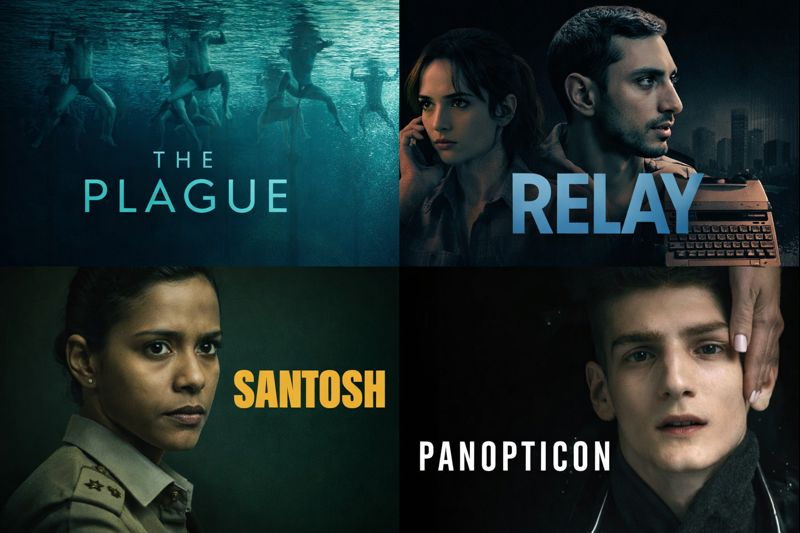
Though varied in genre and geography, these films converge on the same condition: life inside systems that observe, judge, and constrain continuously.
Film | Director | System of Control | Core Condition Portrayed |
The Plague (2025) | Charlie Polinger | Social contagion & moral panic | Fear spreading faster than facts |
Relay (2024) | David Mackenzie | Surveillance & information control | Life built around concealment |
Santosh (2024) | Sandhya Suri | Institutional patriarchy & policing | Identity shaped by authority |
Panopticon (2024) | George Sikharulidze | Social observation | Self-regulation through fear |
Across these films, systems are not overthrown. They are inhabited, endured, and psychologically negotiated.
How movies treat the trend: Control is no longer imposed—it is absorbed
Rather than dramatizing oppression through spectacle, these films depict control as internalized. Tension emerges from anticipation rather than confrontation.
Film | How Control Functions | Narrative Role | Resolution Logic |
The Plague | Social fear & suspicion | Community breakdown | No release |
Relay | Surveillance & erasure | Survival through secrecy | Ongoing concealment |
Santosh | Institutional discipline | Moral compromise | Structural continuity |
Panopticon | Being watched | Behavioral self-policing | Tension persists |
Control is omnipresent but invisible: Systems rarely appear directly, yet govern all choices.
Psychology replaces action: Anxiety replaces physical conflict.
Silence becomes strategy: Withholding speech becomes protection.
Endings deny liberation: Survival does not equal freedom.
Control fatigue becomes the narrative engine.
Director’s Vision: Systems as pressure, not villains
Each director frames control as an environmental condition rather than a plot obstacle. Technique emphasizes atmosphere, procedural logic, and inevitability.
Director | Interpretation of Control | Core Vision | Techniques & Tools Used |
Charlie Polinger | Control as social contagion | Fear spreads collectively | Minimalism, escalation via rumor |
David Mackenzie | Control as data surveillance | Information determines survival | Thriller pacing, concealment mechanics |
Sandhya Suri | Control as institutional patriarchy | Authority shapes morality and identity | Observational realism, procedural framing |
George Sikharulidze | Control as visibility | Watching reshapes behavior | Spatial framing, observational tension |
The shared diagnosis: control sustains itself without constant enforcement.
Why the trend mirrors the current world: Cinema reflects life inside permanent oversight
These films echo a global reality where surveillance, reputational risk, and institutional power are normalized.
Film | Real-World Parallel | Condition Reflected |
The Plague | Viral misinformation | Collective fear dynamics |
Relay | Whistleblower suppression | Information as liability |
Santosh | Gendered policing | Authority regulating identity |
Panopticon | Surveillance culture | Self-censorship |
Control today is procedural, constant, and internalized—precisely as these films depict.
Insights: Control has shifted from force to atmosphere
Industry Insights: Cinema is moving toward system-level tension rather than antagonist-driven conflict. Psychological endurance now defines suspense.Consumer Insights: Audiences recognize the stress of constant judgment and observation. These stories resonate because they mirror lived anxiety.Brand Insights: Visibility must be handled carefully. In a culture of control fatigue, protection and restraint carry more credibility than exposure.
Final Insight: Control no longer needs enforcement—it is lived
Modern cinema reveals that power persists through anticipation rather than domination. Systems endure because people adapt themselves to survive within them.
Control as environment: Systems surround rather than confront.
Endurance over resistance: Survival replaces rebellion.
Silence as safety: Expression becomes risk.
Psychology as battleground: Conflict moves inward.
As long as systems remain omnipresent and impersonal, cinema will continue to explore what it costs to remain intact inside them.
Trend forecast: A winning movie trend shaped by life under constant oversight
This trend aligns with contemporary anxiety around surveillance, identity regulation, and systemic pressure. It replaces spectacle with recognition.
Why this trend is gaining strength
Psychological realism: Chronic stress feels more truthful than dramatic oppression. Control fatigue mirrors daily experience.
Cultural ubiquity: Surveillance and judgment affect nearly all demographics. The metaphor scales globally.
Narrative efficiency: Atmosphere communicates control faster than exposition.
Genre flexibility: The trend fits thrillers, dramas, and social realism.
Structural advantages
High emotional credibility: Subtle tension feels authentic.
Prestige alignment: Festivals reward system-level critique.
Global portability: Control differs; pressure feels universal.
Risks and limits
Restraint fatigue: Excess subtlety risks disengagement.
Limited mass appeal: Some audiences seek clearer antagonists.
Concept flattening: Repetition without variation dulls impact.
Outlook assessment
Dimension | Assessment |
Cultural relevance | Very strong |
Audience resonance | High |
Longevity | Medium–long term |
Commercial scalability | Selective |
Forecast conclusion:This is a winning trend because it reflects how power now feels—everywhere and nowhere at once. As long as people live under constant observation and judgment, cinema will continue to examine how to survive inside systems that never switch off.
Where to watch the movies:
The Plague (2025) by Charlie Polinger: https://www.primevideo.com/detail/0QIS17QKW8C4LBW57FMP2KXJHL/ref=dvm_src_ret_ca_xx_s (Canada)
Relay (2024) by David Mackenzie: https://www.justwatch.com/ca/movie/relay (Canada), https://www.justwatch.com/us/movie/relay (US), https://www.justwatch.com/au/movie/relay (Australia), https://www.justwatch.com/uk/movie/relay (UK), https://www.justwatch.com/fr/film/relay (France), https://www.justwatch.com/it/film/relay (Italy), https://www.justwatch.com/es/pelicula/relay (Spain), https://www.justwatch.com/de/Film/relay (Germany)
Santosh (2024) by Sandhya Suri: https://www.justwatch.com/us/movie/santosh-2024 (US), https://www.justwatch.com/ca/movie/santosh-2024 (Canada), https://www.justwatch.com/uk/movie/santosh-2024 (UK), https://www.justwatch.com/fr/film/santosh-2024 (France), https://www.justwatch.com/es/pelicula/santosh-2024 (Spain)
Panopticon (2024) by George Sikharulidze: https://www.primevideo.com/detail/0HOU2DTATSAG5T0Y6G8YID3RY0/ref=dvm_src_ret_fr_xx_s (France)


Comments