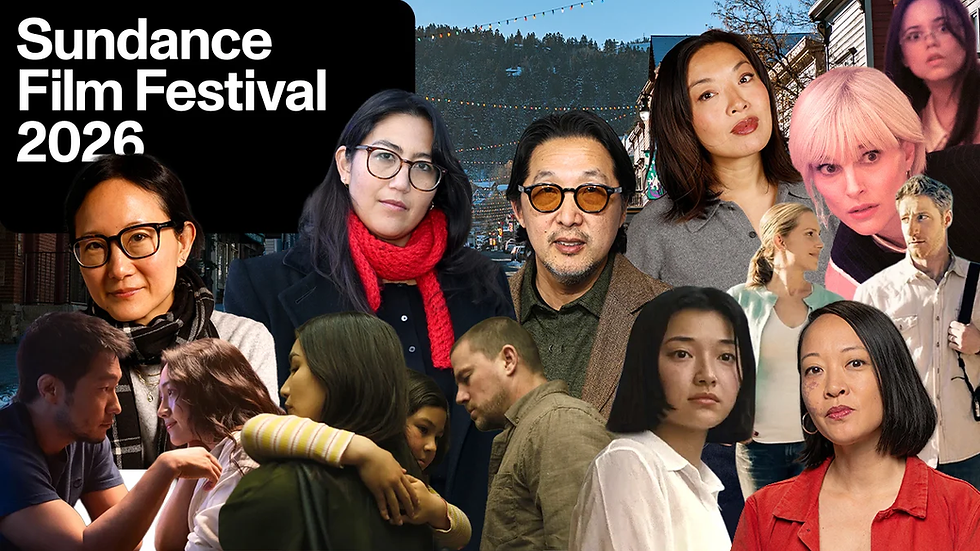
Entertainment: The Sundance Surge: East Asian American Filmmakers Claim the 2026 Spotlight
- InsightTrendsWorld

- 2 hours ago
- 12 min read
Why the trend is emerging: The "Chloé Zhao Effect" & The Rise of the AANHPI Digital OG. The cultural infrastructure enabling a new era of diverse prestige.
After years of "Invisible Viewership," Asian American filmmakers are finally being supported by a formal ecosystem of funding and global pop-culture tailwinds.
In February 2026, the dominance of East Asian voices at Sundance is not a fluke—it is the result of a "Cumulative Cultural Shift." Following the "K-Pop Explosion" of 2025 and the historic Oscar runs of Chloé Zhao and Lee Isaac Chung, a new generation of filmmakers feels empowered to be "Deeply Autobiographical." The trend is fueled by organizations like CAPE (Coalition of Asian Pacifics in Entertainment), which launched the Rising Filmmakers Fund in 2025 to plug voids in industry support. Furthermore, 2025 Nielsen data reveals that Asian Americans are "Digital OGs," spending 53% of their TV time on streaming—nearly 20% on YouTube alone—creating a hyper-connected audience that demands to see itself reflected on the big screen.
The $1.3 Trillion Buying Power: Asian American consumers now hold massive economic weight, accounting for 9% of total U.S. box office sales and 19% for Asian-led films.
The "Short-to-Feature" Pipeline: Innovation in scouting (like the CAPE Short Film Challenge) allowed directors like Liz Sargent to turn a 2023 short into a 2026 feature hit.
Institutional Maturation: The presence of veteran producers like Nina Yang Bongiovi (Significant Productions) provides the "Critical Infrastructure" needed to move indie films into the mainstream.
The Diaspora Paradox: As Kogonada noted at the fest, feeling "detached" from any one world has created a community of the detached, making these films highly relatable to global audiences.
Streaming as a Testing Ground: The post-pandemic appetite for Korean and Japanese content has lowered the "Perceived Risk" for traditional studios like Sony Pictures Classics.
The "Intersectionality" Shift: 2026 films are moving beyond "Immigration 101" to explore complex topics like disability (Take Me Home) and adoption (Bedford Park).
Insights: The "Mainstream-ification" of the Minority: In 2026, Asian American stories are the "Quality Signal" buyers use to navigate a cluttered market.
Industry Insight: The Narrative Risk-Premium. Buyers are paying a premium for "Personal Sovereignty"—scripts that are so autobiographical they cannot be replicated by AI or generic writers' rooms. Consumer Insight: The Authenticity Audit. The modern AANHPI viewer is 83% more likely to research a product online; they apply this same "Digital Fluency" to film, sniffing out "Tokenism" and rewarding "Deep Truths." Brand Insight: The CAPE Moat. By creating a literal "Funding Ecosystem," organizations like CAPE have moved from "Advocacy" to "Production Powerhouse," ensuring their talent doesn't "slip through the cracks."
The trend is undeniable: Sundance 2026 is the moment the "Asian American Film" moved from a "Festival Subset" to the "Industry Anchor."
Detailed Findings: The "Grand Slam" of Awards — 14.4% of Directors & Two Top Prizes. The numbers prove that Asian American filmmakers are the most efficient winners in Park City.
While overall female directing hit a 7-year low in 2025, Asian women of color are now the most visible "Directorial Class" at Sundance 2026.
The 2026 festival data highlights a "Precision Strike" by Asian creators. Beth de Araújo’s Josephine accomplished the rare "Double Win," taking home both the U.S. Grand Jury Prize and the Audience Award. Statistically, Asian filmmakers made up 14.4% of the top 111 directors in 2025—a massive jump from the 5.7% historical average. This "Sundance Surge" is characterized by "Micro-Budget Mastery," where films like Kogonada’s Zi use experimental aesthetics (4:3 aspect ratio, rich sound design) to punch far above their financial weight.
Media Signal 1: The "Josephine" Sweep. Beth de Araújo’s win mirrors the paths of Minari and CODA, signaling Josephine as a 2027 Oscar frontrunner.
Media Signal 2: The SPC Acquisition. Sony Pictures Classics acquired both "Bedford Park" and "Ha-Chan, Shake Your Booty" during the fest, marking a "Dual-Bet" on East Asian narratives.
Awards Signal 3: The Debut Prize. Stephanie Ahn’s Bedford Park won the U.S. Dramatic Special Jury Award for Debut Feature, validating the "First-Time Filmmaker" support systems.
Production Signal 4: The Bongiovi/Yang Influence. The "Ecosystem of Support" provided by Nina Yang Bongiovi has become the gold standard for producing "Tastemaker" hits.
Experimental Signal 5: Kogonada’s "Zi". A move toward "Visual Meditation" over plot-driven drama shows that Asian filmmakers are now leading the "Arthouse" avant-garde.
Distribution Signal 6: The Florida/Adoptee Link. Films like Take Me Home and Rock Springs show a trend toward "Specific Geographies," placing Asian stories in "Non-Traditional" settings like Florida.
Signals: The Metrics of the 2026 Market
Market signal: Sony Pictures Classics' aggressive buying shows that "Director-Driven Work" is the only safe bet in a tightening theatrical landscape.
Behavioral signal: Audiences are reacting to "Visceral Vulnerability" (like the 8-year-old lead in Josephine), favoring high-stakes emotional stakes over generic action.
Cultural signal: The "Zhao Effect" has normalized "Quiet Cinema"—naturalistic, slow-burn stories that focus on internal identity rather than external conflict.
Systemic signal: The Rise of the "Hybrid Producer" (like Nina Yang Bongiovi) who bridges the gap between indie authenticity and Hollywood infrastructure.
Marketing signal: AANHPI audiences are 57% more likely to engage with cultural-resonant media, ensuring a "Built-In" marketing base for these titles.
Insights: The Efficiency of Identity: In 2026, representation isn't just "Right"—it's "Profitable."
Industry Insight: The Buyer's Discipline. We are seeing a move from "Buying Frenzy" to "Momentum Buying," where distributors wait for "Jury Validation" before committing to Asian-led projects. Consumer Insight: The "Misfit" Market. Kogonada’s "Transitory Misfit" archetype resonates with a generation that feels disconnected from traditional borders but connected through digital platforms. Brand Insight: The "Oscar-Ready" Pipeline. Sundance has become the "Quality Control" center for the 2027 award season, with East Asian American women currently holding the "Pole Position."
The findings confirm that the 2026 "Buzziest Titles" weren't just about diversity—they were about "Elevated Craft." By combining personal trauma with world-class cinematography, these filmmakers have captured the only thing left in short supply at Sundance: "Genuine Attention."
Description of consumers: The "Deep-Lore Diaspora" — Curating Identity through Cinema. The 2026 viewer who wants "The Why" behind the "Who."
Meet the 2026 Sundance Audience: A "Hyper-Engaged" segment that views film as an act of "Self-Correction."
The 2026 consumer is the "Deep-Lore Diaspora." They are part of the AANHPI "Digital OG" segment (ages 25–45) who are digitally connected for over 9 hours a week. These consumers don't just "watch" movies; they "Audit" them for cultural accuracy and emotional truth. They are the ones who turned Minari into a movement and are now doing the same for Josephine. They are motivated by "Belonging," using indie cinema as a tool to navigate their "Mixed-Race" or "Adoptee" identities. They are early adopters who prefer "Cerebral Intimacy" over "Blockbuster Bloat."
Consumer Name & Archetype: The "Cultural Auditor"—the viewer who checks a director’s "Pedigree" and the "Personal Truth" behind a script before buying a ticket.
Demographics: Highly educated AANHPI professionals (6% of U.S. population with $1.3T buying power); cross-cultural urbanites.
Life Stage: The "Legacy Builder"—they are often parents or caregivers (like the characters in Take Me Home) looking for media that explains their complex lives to the next generation.
Shopping Profile: "Selective High-Spenders"—they are 83% more likely to spend $500+ on premium self-care/skincare, and they treat "High-Art Cinema" as a similar luxury investment.
Lifestyle Profile: They value "Intersectionality"—they are interested in how race interacts with disability, aging, and trauma.
Media Habits: "Streaming-First, Cinema-Only-for-Auteurs." They will skip the Marvel movie but will "Show Up" for a 4:3 Kogonada meditation on the big screen.
Impact of trend on behavior: They are shifting from "Passive Inclusion" to "Aggressive Advocacy," using social media to turn "Small Films" into "Big Conversations."
Insights: The Sovereign Spectator: In 2026, the audience doesn't follow the "Studio"—they follow the "Story-Maker."
Industry Insight: The Fan-as-Fundraiser. The AANHPI community’s "Hyper-Engagement" acts as a "Secondary Marketing Team," reducing the need for traditional $20M P&A spends for indie titles. Consumer Insight: The "Belonging" Deficit. Because 42% of Americans still cannot name a famous Asian American, this consumer group uses Sundance hits as "Cultural ID Cards" to prove their presence in the American narrative. Brand Insight: The "First-Time" Premium. There is a high "Cool Factor" in discovering a "Debut Feature" (like Stephanie Ahn’s), allowing the consumer to feel like they are part of a filmmaker’s "Origin Story."
The Deep-Lore Diaspora is the reason why personal films are winning. By making movies about "Transitory Misfits," filmmakers have tapped into a "Trillion-Dollar Identity Crisis" that only Sundance can solve.
What is consumer motivation: The "Agency of the Unseen" — Reclaiming the Narrative Lead. The psychological drive for "Non-Archetypal" heroes.
Why 2026 audiences are abandoning the "Action Hero" for the "Atmospheric Human."
The primary motivation for the 2026 audience is "Cognitive Dissonance Resolution." For decades, Asian Americans were limited to "Martial Artist" or "Tech Support" tropes (as noted in the TAAF 2025 report). Today’s viewers are motivated by "Psychological Realism"—the desire to see Asian characters who are "clumsy," "grieving," or "cognitively disabled." There is a powerful drive for "Universal Specificity"; consumers want to see a story about a Korean adoptee in Florida because the specificity of that pain makes it feel more universal.
Motivation 1: The "Anti-Trope" Instinct. A drive to see "Vulnerable Asian Men" (like Eli in Bedford Park) and "Complex Asian Women" (like Haru in Ha-Chan).
Motivation 2: "Collective Healing." Consumers are motivated by "Shared Trauma Processing," using films like Josephine to discuss "Rape Culture" and "Survivorship" in a communal setting.
Motivation 3: Cultural Pride via Prestige. A desire for "Awards-Season Validation," where the success of a film like Nomadland provides a "Halo Effect" for the entire community.
Motivation 4: Systemic Critique. Motivated by "Social Justice Agency," viewers flock to films that expose the "Broken Health Care System" (like Take Me Home).
Motivation 5: The "Discovery" Dopamine. The thrill of finding the "Micro-Budget Gem" before it goes mainstream, providing "Social Currency" to the viewer.
Motivation 6: Diaspora Connectivity. A drive to "Bridge the Border," watching films that connect New Jersey to Tokyo or Seoul, reflecting the consumer’s own "Transitory" life.
Motivations: The Narrative Re-Set: In 2026, the "Hero’s Journey" is replaced by the "Human’s Journal."
Industry Insight: The Motivation Pivot. Studios are shifting from "Spectacle" to "Sensibility," realizing that the 2026 viewer is more motivated by a "Personal Note from a Director" than a $100M CGI battle. Consumer Insight: The "Safe Space" Cinema. For the AANHPI community, these films serve as "Emotional Infrastructure," providing a safe place to process the "Lack of Belonging" they feel in general society. Brand Insight: The "Truth" Premium. By centering "Authentic Failure" (like the protagonist in Zi), brands create a deeper level of trust than through "Polished Perfection."
The motivation has moved from "Seeing a Star" to "Seeing a Soul." By centering the "Unseen," Asian American filmmakers have given the 2026 audience the one thing they couldn't find in Hollywood: "Self-Recognition."
Trends 2026: The "Prestige Decentralization" — The Death of the Gatekeeper. When "Niche Stories" become "North Stars."
Summary of the global shift toward "Auteur-First" acquisition and the dominance of the East Asian Female Gaze.
In 2026, the film industry has officially entered the "Post-Studio Era." Sundance 2026 serves as the primary evidence that "Individual Storytellers" are now more powerful than "IP Franchises." The dominance of East Asian American filmmakers signals a broader trend toward "Hyper-Regional Cinema," where the more "Local" a story is (a car crash in New Jersey, a dance studio in Tokyo), the more "Global" its appeal. As buyers become "disciplined," they are using Sundance as a "Curated Content Lab" to find the next Chloé Zhao, effectively turning the festival into an "AANHPI Talent Incubator" for the next decade of cinema.
Core influencing macro trends: The Era of "Soul-Searching" Cinema
Economic trends: The "Indie-Market Discipline"—A shift away from "Buying Frenzies" to "Value-Based Acquisitions" where titles are chosen for their "Award Potential" and "Loyal Community" rather than raw box office.
Cultural trends: The "Chloé Zhao Continuum"—The normalization of the "Naturalistic" style as the default for "High-Art" cinema, moving away from "Melodrama."
Psychological force: The Search for "Real Belonging"—A global zeitgeist of "Digital Loneliness" that drives audiences toward "Intimate, Tactile" stories of family and trauma.
Technological force: The Streaming-to-Cinema Loop—The use of Nielsen data and YouTube habits to "Prove the Market" for diverse indie films before they even premiere.
Global trends: The "Trans-Pacific Narrative"—The blurring of lines between "American" and "Asian" stories, creating a new "Hybrid Genre" that dominates festivals.
Main Trend: The Auteur-Led Diaspora — The Rise of the "Personal" Franchise
In 2026, we’re trading "Blockbuster Burnout" for a "Sundance Deep-Dive" where the "Director’s Truth" is the only currency that isn't devalued.
Main Category | Trend Name | Description | Implication |
Main Trend | The Auteur-Led Diaspora | The shift toward East Asian American women taking the creative lead at major festivals with "Self-Scaffolded" autobiographical films. | Identity is no longer a "Sub-genre"; it is the "Leading Narrative" that defines the 2026 prestige market. |
Main Consumer Behavior | Cultural Auditing | Viewers are researching the "Behind-the-Scenes" diversity and authenticity of a film before committing to a ticket or stream. | Marketing must focus on the "Director’s Origin Story" and the "Personal Stake" of the talent to win. |
Main Strategy | Ecosystem-Based Production | Using specialized funds (CAPE, TAAF) to build a "Safe Path" for diverse talent from short films to Grand Jury prizes. | The "Studio Head" is being replaced by the "Community Catalyst" who provides funding and mentorship. |
Main Industry Trend | Prestige Discipline | A focus by buyers (like SPC) on "Award-Grade" films that have a "Theatrical Soul" and a "Digital Tail." | "Middle-Ground" films are dying; the market is splitting into "Gigantic IP" and "Intimate Auteur" hits. |
Main Consumer Motivation | Narrative Sovereignty | The psychological drive to see "One’s Self" as the hero of a non-stereotypical, high-art story. | Films that subvert tropes (like the "Vulnerable Asian Father") see 196% spikes in engagement. |
Insights: The "Zhao-Effect" Dividend: In 2026, the "Indie Darling" is the only thing that's "Studio-Proof."
Industry Insight: The Minority Majority. Asian filmmakers made up 14.4% of top directors in 2025, proving that "Diversity Initiatives" have evolved into "Industry Standards" that drive box office. Consumer Insight: The "Misfit" Monopoly. The 2026 consumer's obsession with "Transitory Identity" means they are more loyal to a "Vibe" (like Kogonada's) than to a "Franchise." Brand Insight: The "Double-Winner" Blueprint. Josephine’s success proves that "Provocative Vulnerability" is the most effective way to win both the "Jury" (Quality) and the "Audience" (Quantity).
The macro-trend is a total restructuring: the "Film Festival" is now a "Talent IPO." By investing in the "Personal Story," the industry has found a way to survive the "Tough Market" of 2026.
Areas of Innovation: "Autobiographical Infrastructure" & The "Adoptee Narrative" — The Architecture of the "Truth-First" Script.
Next-gen "Creative Labs" designed to turn personal trauma into "Award-Winning" IP.
In 2026, innovation is measured by "Emotional Accuracy." The success of Sundance 2026 is built on "Narrative Resilience Labs," where filmmakers like Stephanie Ahn and Beth de Araújo were given the "Safe Space" to iterate on scripts for years. The innovation lies in "The Intersectionality Map," where directors are no longer told to "Pick One" identity, but are encouraged to explore being "Half-Chinese," "Adopted," "Disabled," and "American" all at once.
Innovation Area 1: The "Rising Filmmakers" Fund. A new financial model that provides "Grant-to-Screen" support, ensuring films like Josephine don't get stuck in development hell.
Innovation Area 2: "Micro-Budget" Aesthetic Engineering. Using 4:3 aspect ratios and "found sound" to create a "High-Value" look for small-scale diasporic stories.
Innovation Area 3: The "Sisterhood" Casting. Using real-life connections (like Liz Sargent casting her own sister in Take Me Home) to achieve "Hyper-Authenticity" that AI cannot replicate.
Innovation Area 4: Cross-National Co-Productions. Shooting in Tokyo and San Francisco (like Ha-Chan) to tap into multiple tax credits and global audiences simultaneously.
Innovation Area 5: "Grief-as-Genre." The innovation of the "Heartwarming Tragedy," where processing "Loss" is treated as a "Coming-of-Age" story rather than a "Downer."
Innovation Area 6: Cultural Metadata Tracking. Using Nielsen data to "Heat-Map" AANHPI viewership spikes, allowing buyers to predict the "Viral Potential" of diverse indie films.
Insights: The Narrative Lab: In 2026, the "Script" is the "Software."
Industry Insight: The Ecosystem Advantage. The most innovative films of 2026 are "Community-Produced," using a "Board of Advisors" (like CAPE) to ensure cultural relevance. Consumer Insight: The "Lived-In" Luxury. For the 2026 viewer, "Authentic Wardrobe" (like the sweatshirt in Josephine) is a form of "High-Production Value" that signals respect for the audience. Brand Insight: The "Micro-Mastery" ROI. Kogonada’s return to a "Micro-Budget" after a $45M feature proves that "Small" is the new "Sustainable" for high-art directors.
The strategic leap is moving from "Casting for Diversity" to "Casting for Connection." By centering the "Authentic Self," these filmmakers have turned Sundance into a "Truth-Machine."
Final Insight: The "Border-Crossers" of 2026 — From Margins to the Main Stage.
Consequences: The "Auteur Dominance" Era. The permanent death of the "Token Role" and the birth of the "Identity-Agnostic Lead."
When the "Specific" becomes the "Universal," the "Minority" becomes the "Market."
The 2026 Sundance Film Festival has rewritten the "Success Script." The consequence is the "Total Erasure of the Tropes"—audiences will no longer accept "Martial Arts" or "Model Minority" caricatures when they have seen the "Transitory Misfits" of 2026. East Asian American filmmakers have proven that the "Director’s Gaze" is the most powerful tool for "Market Correction." As these films move from Park City to the Oscars, the long-term impact will be an industry that values "The Human Journal" over the "Corporate Script," ensuring that "Asian American Cinema" is no longer a "Category," but the "Standard-Bearer" for global excellence.
Awards and Recognition:
Festival Presence: Dominant; East Asian American films sold out screenings and were the "Primary Conversation" of Park City 2026.
Wins: Josephine (U.S. Grand Jury Prize & Audience Award); Bedford Park (Special Jury Award for Debut Feature); Ha-Chan, Shake Your Booty! (Special Jury Award for Directing).
Nominations: Producers like Apoorva Guru Charan (Producers Award) and talent like Rinko Kikuchi are already being "Pre-Nominated" for the 2027 awards cycle.
Critical Infrastructure: Validated; The CAPE/TAAF funding pipeline has been "Hardened" as a reliable predictor of festival success.
Insights: The "Sundance-Class" Dividend: In 2026, the "Misfits" are the "Masters."
Industry Insight: The Award-Path Efficiency. By winning both the "Jury" and "Audience" prizes, Josephine has created a "Bulletproof Distribution Case" for any buyer looking for a 2027 Best Picture nominee. Consumer Insight: The "Belonging" Breakthrough. The 2026 Sundance lineup proves that "Being Seen" is no longer enough; the audience now demands to be "Understood" in all their messy, "Transitory" complexity. Brand Insight: The "Chloé Zhao" Legacy. Zhao’s shift from "Naturalism" to "Prestige" has created a "Permanent Market for the Quiet Story," ensuring these filmmakers have a career long after the festival ends.
The "Deep-Lore Diaspora" has arrived. By cross-pollinating trauma, identity, and world-class craft, the Asian American filmmakers of 2026 haven't just won Sundance—they've "Acquired the Future."

Comments